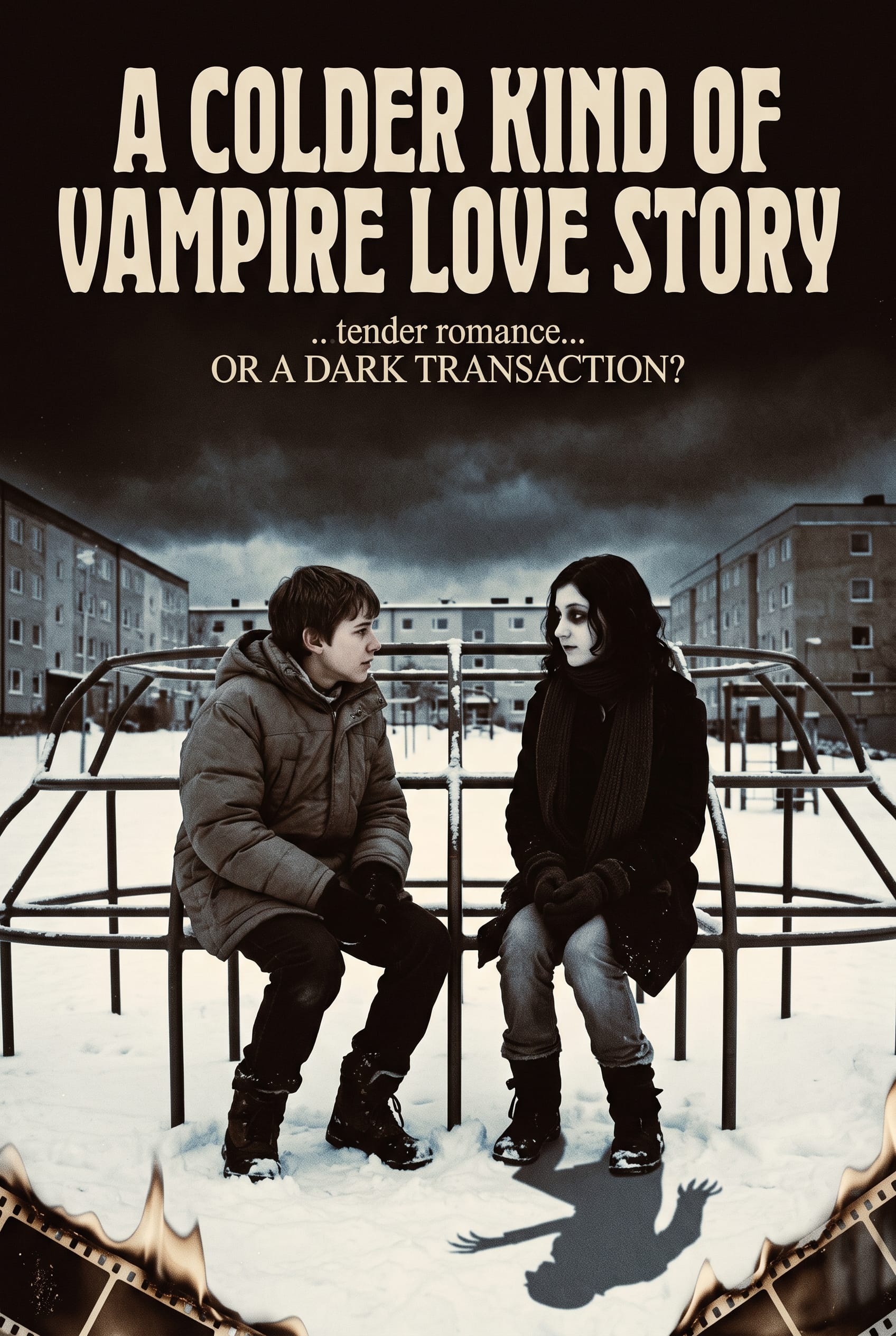
This Let the Right One In 2008 review starts with the direct answer: Tomas Alfredson’s Swedish vampire film, about a bullied twelve-year-old boy and the centuries-old vampire who moves in next door, is often described as horror’s gentlest, most tender love story — but it’s actually colder and more transactional than that reputation suggests, even as it remains
one of the best vampire movies ever made. Everyone who talks about
Let the Right One In wants to tell you how gentle it is. The tender vampire movie. The quiet one.The one where the horror is really about loneliness, and the blood is almost beside the point. I’ve read that framing enough times now that I’ve started to notice how much work the word “gentle” is doing, and what it’s covering for. This is Tomas Alfredson’s 2008 adaptation of John Ajvide Lindqvist’s own novel, and it is a genuinely great film. It is not, when you actually sit with what happens in it rather than what people remember happening in it, a gentle one.It premiered at the Gothenburg Film Festival in January 2008 and opened wide in Sweden that October, which means it shared a calendar year with Twilight, which hit American screens in November of the same year.I bring that up once and then I’m done with it, because the comparison has been made to death and it’s lazy — but it’s also true that 2008 handed audiences two vampire love stories about a human kid and a supernatural one, and only one of them has a scene where the vampire’s guardian pours acid on his own face so the police can’t identify his corpse. That’s the year we were living in, and I’m flagging it for context rather than comic effect.Oskar is bullied at school with a specificity that never tips into melodrama — a boy named Conny leads a small pack that forces him to squeal like a pig, over and over, until the phrase becomes a kind of ambient weather in his life. He meets Eli, who has just moved into his apartment courtyard in Blackeberg with a much older man named Håkan, and who tells him almost immediately that they can’t be friends. She’s lying, or she doesn’t know it yet, or both. What follows is not a rescue story. It’s an exchange.Here’s where this Let the Right One In 2008 review lands, and I’ll say it early instead of building to it: the reputation this film has as a tender coming-of-age story with vampire trimmings undersells what’s actually on screen, which is a much colder film about an economy — a boy’s isolation being harvested by something that needs exactly that isolation to survive, dressed in enough craft and restraint that audiences mistake the transaction for a romance. The craft is real. The restraint is real.But restraint isn’t the same thing as tenderness, and this film gets credit for the second when it’s only actually offering the first.
The Cinematography and Sound Design
Start with what the camera is doing, because it’s doing more than most reviews credit it for. Cinematographer Hoyte van Hoytema shot on a fixed Arri 535B with almost no handheld work, relying on dolly-based tracking instead of the Steadicam glide that’s become the default grammar for intimacy in modern film. The production shot primarily in Luleå, far north of Blackeberg’s actual Stockholm suburb, specifically because the crew needed real cold and real snow rather than a location that merely looked cold on a color-graded monitor.There’s something almost funny about a film this committed to depicting isolation having to travel that far to find isolation honest enough to photograph — but the result is a landscape that never once reads as set dressing. The snow functions as the actual temperature the characters are living in, not as atmosphere layered on top of a warmer shoot.Alfredson pushed the same logic into sound. He’s said outright that early passes at sound design and music made certain sequences feel “American, in a bad way,” and that stripping those elements back was what let the film become itself. What’s left is deliberately, almost stubbornly analogue — footsteps, breathing, the wet specific sounds of Eli feeding, built in part from actual animal-noise recordings layered under the human performances. It’s an ugly, tactile choice in a film that otherwise photographs beautifully, and it’s doing more of the actual horror-movie work than anything in the script.Johan Söderqvist’s score sits underneath all of that showing genuine discipline about when to show up at all. Söderqvist has talked about wanting melody and harmony to carry the film even while the tone stayed dark — “there is always a sense of hope and beauty,” in his own words — and he built part of that around the waterphone, an instrument that produces a sound closer to a struck bell underwater than anything resembling a conventional string or brass cue. Long stretches of the film have no score whatsoever.When it does arrive, it earns the space it’s been given rather than filling silence out of habit, which is a harder trick than composers usually get credit for.
The Performances: Hedebrant and Leandersson
Kåre Hedebrant’s Performance as Oskar
Kåre Hedebrant plays Oskar without a single moment of performed suffering. He doesn’t cry on cue, doesn’t deliver a speech about what the bullying has done to him — he just goes quietly feral in the scenes where it counts, rehearsing knife-thrusts alone in the courtyard at night, addressing an imaginary tormentor with more conviction than he ever manages with an actual person standing in front of him. It’s a performance built entirely out of things a twelve-year-old boy wouldn’t say out loud, which is exactly correct for the character.
Lina Leandersson’s Performance as Eli
Lina Leandersson’s casting is its own small story worth knowing before you watch her work. The production ran a year-long, nationwide search before landing on her, and she auditioned three separate times without initially understanding what role she was even up for — she’s said she assumed it was “a more usual role” until the vampire elements became clear, at which point she got genuinely excited about it. What she delivers on screen is a performance built on stillness and a specific kind of patient watching, and it’s remarkable work for a twelve-year-old.What undercuts it slightly, at least for me, is a production decision that happened after she finished acting: Alfredson had her dialogue entirely redubbed by an adult actress, Elif Ceylan, because he felt Leandersson’s actual voice was “too high” and needed to sound more androgynous. Leandersson herself has been gracious about it, joking that her real voice sounds strange to her anyway. I understand the artistic logic.I also think it’s worth saying plainly that the film’s celebrated gender ambiguity was partly manufactured after the fact, over a real child’s real voice, and that detail rarely makes it into the takes about how subtle and tasteful this film is.
How the Film Changes Eli and Håkan From the Novel
Which brings me to the scene everyone actually wants to discuss and almost nobody discusses accurately. Oskar tests the old vampire folklore by inviting Eli into his apartment and then, once she’s standing in the doorway, deliberately withholding the actual words of permission. She starts to bleed from her eyes, her ears, every pore at once, and it’s genuinely upsetting to watch — restrained the way the rest of the film is restrained, which somehow makes it worse.Alfredson has said he originally wanted to cut this entire beat, that he thought the invitation rule was too much of an old vampire-movie cliché to bother with. Lindqvist, adapting his own book, insisted it stay in. He was right, and it’s a little funny that the director’s instinct on his own signature scene was this wrong.The film handles Eli’s actual nature with a lighter touch than the novel does, and this is where the sardonic case against the “gentle masterpiece” reading gets its sharpest edge. Lindqvist’s book is explicit: Eli was born a boy, castrated as a child, and has been Håkan’s — or some previous Håkan’s — companion for a very long time under circumstances the novel does not soften. The film reduces all of that to a single, blink-and-you-miss-it shot of a scar during a scene where Oskar sees Eli half-dressed, never explained, never returned to.He’s talked about considering a castration flashback and rejecting it, and his stated reason wasn’t squeamishness about the material — it was that the effect would have required using a pig as a stand-in for human flesh, and he wasn’t willing to do that to an animal. That’s a genuinely decent reason. It’s also not an argument about narrative restraint, whatever the film’s reputation for restraint has absorbed it into. The scene got cut for a production-ethics reason that has nothing to do with the film’s stated philosophy of showing less and trusting the audience more.Håkan gets the same treatment. In the novel, his relationship to Eli carries real, sustained pedophilic weight — a man who has spent his life in service to something that first found him as a child himself, and never got to stop. He’s said directly that he didn’t think the film could handle a theme that serious “in a satisfying manner,” and chose instead to build Håkan as a pathetic, devoted, almost sympathetic old man who kills because he’s told to and clearly hates himself for it.Per Ragnar plays that read beautifully — the acid-to-the-face scene, confirmed in the film’s own news broadcast about “self-inflicted facial wounds” making identification impossible, is the only truly frightening thing he does, and it’s frightening because it’s the one moment where his devotion curdles into something with real teeth. But softening Håkan this much also softens what the film is actually arguing about Oskar’s future, and that’s the part worth sitting with longer than the marketing wants you to.
The Train Scene, and Why It Isn’t What It Looks Like
Because the ending is not, whatever the poster suggests, a boy getting a girlfriend. Oskar climbs aboard a train with Eli hidden in a trunk at his feet, tapping out morse code against the lid — the same code he’d tapped through his bedroom wall to reach her days earlier — and the film wants this to read as tenderness, two lonely children finally on the same side of something.What it actually shows, if you track what Håkan was and what Oskar is about to become, is a fourteen-year-old just beginning an apprenticeship in exactly the same arrangement that hollowed Håkan out over decades: find her food, protect her secret, disappear a little more each year until there’s nothing left of you that isn’t in service to her survival. The film never states this outright. It doesn’t need to.Every structural beat of Håkan’s arc has already told you what Oskar’s arc is going to look like in twenty years, and the fact that the ending plays as sweet anyway is the single most impressive piece of misdirection in the entire movie.
Let the Right One In 2008 Review: Final Verdict
None of this is a knock on the craft, which really is close to flawless — the Guldbagge Awards agreed, handing the film Best Director, Best Screenplay, Best Cinematography, Best Sound, and Best Production Design in a single ceremony, and Roger Ebert gave it three and a half stars with a line I think about more than almost anything else written about this film: it takes vampires as seriously as the versions of
Nosferatu do, he wrote, “and that is very seriously indeed.” He’s right, and that seriousness is exactly why the “gentle” reading bothers me.A film this committed to taking its vampire literally — to the blood, the invitation rule, the decades of servitude required to keep one alive — earns its recommendation as the colder thing it already is, without needing a love-story softening applied on top.The bullying is real bullying, staged with the same unglamorous precision as everything else, right down to the recurring “squeal like a pig” taunt that opens the film and gets echoed back, almost tenderly, in Eli’s own voice near the end — “those were the first words I heard you say,” she tells him, and it’s not clear whether that’s affection or appraisal.The swimming pool sequence that closes out the bullying plot is where the film’s restraint finally shows its actual purpose. Conny and his crew corner Oskar in the pool during a swim class, hold his head under, and count down a cruel little contest — an eye for an ear, one of them says, referencing an earlier injury Oskar caused with a stick, the film keeping its own continuity tighter than most horror movies bother to. Eli arrives.What happens next isn’t shown so much as suggested through water, sound, and the aftermath — a severed limb, a body missing pieces, chaos at the pool’s edge — and the film’s own English subtitles simply go silent for the entire sequence, no dialogue transcribed at all, because there’s none to transcribe. That absence is the whole aesthetic in miniature: show almost nothing, and let the almost-nothing be worse than anything explicit could have managed.I keep coming back to this film for the coldness underneath it, and for how much of the writing around it insists on the warmth instead. It’s a film about a transaction dressed as a friendship, a gender revelation reduced to one shot for reasons that have as much to do with animal welfare as artistic philosophy, and an ending that reads as romantic only if you don’t look too hard at what Håkan spent his whole life becoming.Every piece of craft in it — the camera, the sound, the score, both lead performances — is in service of making that transaction feel inevitable rather than tragic. That’s a much harder thing to pull off than tenderness, and it’s the actual reason this film has outlasted almost everything else the genre produced that decade. Ethan breaks down the train-scene finale in
Let the Right One In (2008) Ending Explained, and the textual details hiding in plain sight in
Let the Right One In (2008) Hidden Details.
Ethan’s Score: 9 / 10Let the Right One In (2008) — Frequently Asked Questions
What’s the Verdict of This Let the Right One In 2008 Review?
This Let the Right One In 2008 review argues the film earns its reputation as one of the best vampire movies ever made through its restraint and craft, even though that restraint gets mistaken for tenderness. Tomas Alfredson’s fixed camera, analogue sound, and disciplined score serve a colder, more transactional story than its gentle reputation suggests. Ethan’s score: 9/10.
Is Let the Right One In (2008) Based on a Book?
Yes. Let the Right One In (2008) adapts John Ajvide Lindqvist’s novel of the same name, with Lindqvist writing the screenplay himself. The film softens some of the book’s harsher material, including Eli’s backstory and Håkan’s relationship to her, favoring suggestion over explicit detail on screen.