When I was eight, there was an ice cream man who came down our street in Ohio every afternoon, same three-note bell every time — three rings, a pause, three rings. We heard it from wherever we were in the yard and ran for the sidewalk like it was our idea. It took me decades to understand what that man actually knew. Which streets had traffic and which didn’t. Which mothers let their kids out the door with change in their pockets and which didn’t. What time the porch lights came on, which told him whose parents worked late.
He had a more detailed map of that neighborhood’s afternoon than any of us could have drawn, and every kid on that street thought the run to the curb was a decision they’d made themselves. I don’t remember his face particularly, which strikes me now as strange, given how much of my early childhood organized itself around that sound. I remember the bell better than I remember him. That’s probably the whole point of a system that works — you’re not supposed to notice the person running it, only the thing he’s offering you.
Systems like that don’t need you to notice them succeeding. They just need you to keep running for the curb.
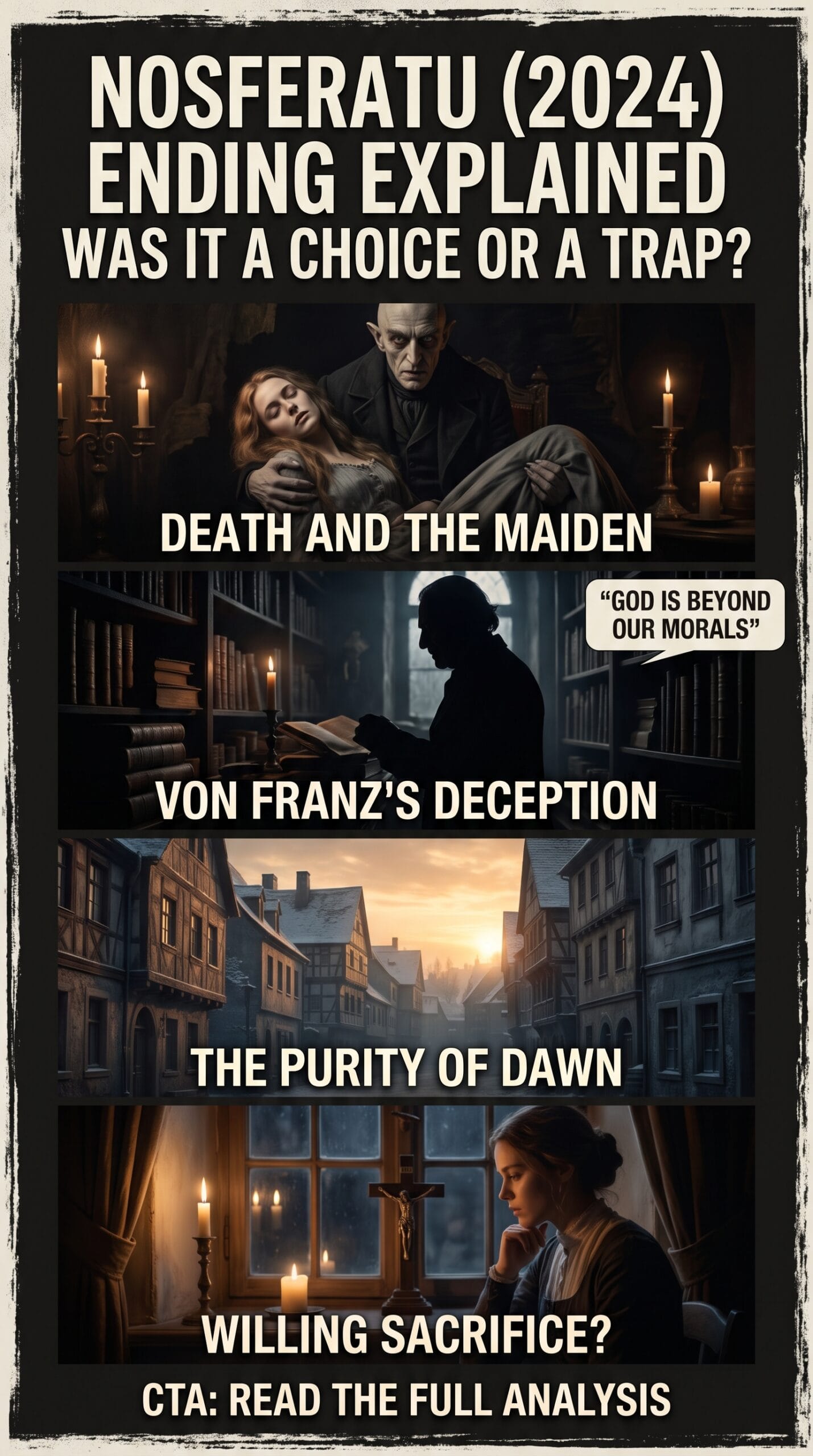
Nosferatu (2024), directed by Robert Eggers, ends with Ellen Hutter and Count Orlok both dying at dawn — she from blood loss after willingly letting him feed on her through the night, he destroyed by what Eggers calls the “purity of dawn” the moment the sun rises.
This Nosferatu 2024 ending explained walks through exactly how it happens, what Professor Von Franz orchestrated to make it possible, and what the film is actually arguing underneath the tragedy — if you want the full case for why the film works as a whole, I laid that out in my Nosferatu (2024) review.
I don’t bring that up lightly, and I don’t bring it up as a comparison I’m proud of making. But it’s the thing that wouldn’t leave me alone once I actually sat with the last twenty minutes of Robert Eggers’ Nosferatu instead of just being moved by them. Because the ending of this film is being sold to you, inside the film, by three different characters, as three different things — a sacrifice, a redemption, a destiny. Von Franz calls it necessity. The prophecy calls it willing. Only one of those words pretends the decision belongs to Ellen.
Every one of those words is doing the same job the bell did. It’s telling you the choice belongs to the person making it. I don’t think it does. I think the map was already drawn.
What Actually Happens at the End of Nosferatu (2024)
Professor Albin Eberhart von Franz — the eccentric Swiss occultist who’s spent the whole film positioning himself as the one adult who understands what’s hunting Wisburg — finds, in the medieval texts and woodcuts he’s been consulting throughout the story, that there is exactly one way to end Nosferatu’s plague: Ellen has to give herself to him willingly, of her own will, and let the sunrise catch him still feeding on her. Von Franz tells Ellen this. Not the town, not Thomas — Ellen.
He gets her to agree, and gets her to agree to keep Thomas away from the truth of what she’s about to do. Then, on the night it needs to happen, he arranges for Thomas to be elsewhere — sent, with Harding, to search Orlok’s coffin at Grünewald Manor, a location Von Franz already knows will be empty, because the plan requires the husband occupied and useless while the wife does the one thing that can save everyone he loves. Thomas spends the film’s final act chasing a decoy his own mentor built for him — one piece of a much larger occult mechanism Von Franz sets in motion, the specific rituals and real Goetic names behind it covered in full in Nosferatu 2024 Hidden Details.
None of this happens by accident, and the film is careful to show the mechanics rather than just imply them. Sending Thomas and Harding to search Orlok’s coffin at Grünewald Manor isn’t framed as a mistake or a wrong guess — it’s framed as a plausible, defensible piece of vampire-hunting strategy, the kind of thing either man would agree to on its own logic. That’s what makes the deception effective: a structure built out of individually reasonable instructions, each one plausible enough on its own that nobody has any reason to add them up.
Nobody has to be fooled by something absurd. They just have to be handed a task reasonable enough that refusing it would look like the unreasonable choice.
How Ellen and Orlok Die: The Nosferatu 2024 Ending Explained
Ellen invites Orlok into her bedroom. She lets him feed on her through the night — and the film is specific that it’s not passive; she wants this in the way you can want something that’s also going to kill you, which is its own kind of horror the film has been building toward since Ellen’s possession sequences early in the story. The film doesn’t flinch from that want, and it doesn’t sanitize it into pure victimhood either — that refusal to simplify her is, I think, the single bravest choice the script makes in its final act.
Orlok is so consumed by her, so lost in what he’s finally allowed himself after two hours of restraint, that he doesn’t register the sky changing. Thomas arrives at the door just as dawn breaks — too late to stop anything, in time only to hold Ellen’s hand while she takes her last breath. She dies from the blood loss, quietly, and by every account of the people who made this film, she has just enough left in her to see Thomas again before she dies.
What the film gives Thomas in that last minute matters more than it first seems. He doesn’t arrive in time to stop anything, but he arrives in time for one thing: Ellen seeing him again before the end. That’s not nothing, and I don’t think the film intends it as nothing — but it’s also not absolution.
Thomas spends the entire final act doing exactly what a good husband is supposed to do, chasing the threat, protecting the household, following the expert’s instructions, and none of it amounts to anything except being present for the last few seconds of a plan he was deliberately kept out of. The film doesn’t punish him for that. It just doesn’t let him fix it either, which might be a harder thing for a story to do to a character than punishing him outright.
Orlok dies seconds later, caught in the first light, and Eggers has been careful in interviews to correct the way people describe this part: it isn’t the sunlight itself that kills him. It’s what he calls the “purity of dawn” — an older, stranger piece of vampire folklore than the one most horror movies use, where the requirement isn’t darkness but the specific window before the first crow of the rooster. He’s a thing that exists on borrowed time, and the borrowing has a deadline written into it older than he is.
The Purity of Dawn: Nosferatu’s Vampire Folklore Explained
There’s a symmetry in that folklore choice that I don’t think is accidental either. Orlok is destroyed by purity — dawn’s purity, specifically, not just its brightness — in the same scene where Ellen is being consumed for the sake of a plan built entirely around the word “willing.” Purity and willingness end up doing structurally identical work in this film’s final minutes: both are conditions that have to be certified as real before the magic — the folklore, the ritual, the prophecy — will actually function.
Orlok’s death requires dawn to be pure in a specific technical sense the film’s mythology defines. Ellen’s death requires her surrender to be willing in a specific technical sense Von Franz’s mythology defines. Neither condition gets interrogated by the story’s own internal logic once it’s been declared satisfied. A folklore rule and a moral rationalization end up functioning as the exact same kind of permission slip — different vocabularies, same job.
The Death and the Maiden Ending, Explained
The last image of them together is a tableau, and Eggers has said as much outright — he’s building a “Death and the Maiden” composition, the old Northern Renaissance motif where a skeletal death figure is shown entwined with a young woman. It’s a motif with real weight behind it — German Renaissance painters and printmakers used it constantly, it grew out of the older Danse Macabre tradition, and composers were still returning to it centuries later; Schubert wrote some of his most famous work under that exact title.
Every version of it is doing the same thing: putting mortality and desire in the same frame and refusing to let the viewer separate them — it’s the same argument about vampires as vermin and appetite that I trace across the best vampire movies more broadly, just staged here as a single tableau instead of an entire film. Eggers has said the contrast between Lily-Rose Depp’s face and Bill Skarsgård’s makeup in that shot is the entire point of how he lit and framed it. It’s not an accident that it reads like a painting. It’s built to.
Why Von Franz Says “God Is Beyond Our Morals”
I want to sit with the plan itself for a second, because this is where the film stops being a tragedy that happens to Ellen and starts being something closer to an engineering project that uses her. Von Franz’s justification for all of it — for withholding the truth from Thomas, for orchestrating a decoy errand for the two men who love her most, for letting Ellen believe this was entirely her decision to make — is a line he delivers laughing, joyfully, while Thomas is screaming at him that what he’s done isn’t moral: God is beyond our morals.
It’s the most chilling sentence in the film precisely because it isn’t wrong within the film’s own logic. The plague does end. The town is saved, and Von Franz’s method works exactly as he said it would. And none of that changes the fact that he built the entire mechanism in secret, briefed exactly one person on the real terms, and structured the last day of that person’s life so that the men who loved her would be somewhere else when it happened.
I want to be fair to Von Franz for a second, because the film is fair to him, and pretending otherwise would flatten an argument that works precisely because it doesn’t have an easy villain. He isn’t lying about the stakes. Wisburg really is dying. The plague really does end the moment Orlok does.
If you ran the tape forward with Von Franz telling Thomas everything from the start, it’s not obvious the outcome changes — a husband who loves his wife does not calmly agree to let her die, informed consent or not, and Von Franz may have understood that better than anyone else in the room. That’s the uncomfortable part. His manipulation might have been necessary to get the correct outcome. Necessary and justified aren’t the same word, and the film seems to know the difference even when its own characters don’t.
It’s the kind of distinction that matters more in hindsight than it ever does in the room where the decision actually gets made, which is exactly why Von Franz gets to make it uncontested.
Von Franz never says he was right to deceive everyone. He says morality doesn’t apply to what he did, which is a different and, I’d argue, more honest claim — it’s an admission that he can’t defend the deception on moral terms and has decided not to try. Most manipulators in horror films either believe their own cover story or get unmasked as frauds who never believed in the cause at all. Von Franz is neither.
He knows exactly what he did, knows it wouldn’t survive an honest accounting, and has already decided the outcome buys him out of needing one. That’s a colder position than villainy. Villains usually want you to think they’re right.
Was Ellen’s Sacrifice Really a Choice?
That’s the part the film doesn’t resolve, and I don’t think it’s supposed to. Ellen’s sacrifice is framed, by the prophecy Von Franz reads from an old woodcut, in language that sounds like agency: her willing sacrifice broke the curse and freed them from the plague of Nosferatu. Willing.
The word is doing enormous work in that sentence, because everything upstream of her willingness — what she was told, when she was told it, who else knew, who was kept in the dark and why — was decided by somebody else, for reasons that were, however sincerely held, his to weigh and not hers to know about until the terms were already set.
Bill Skarsgård said something in an interview that I keep turning over, about what’s actually happening between Ellen and Orlok in that room: “It isn’t love, it’s something else, but love is maybe the closest thing to it that you can kind of relate to.” I think that sentence describes Von Franz’s relationship to Ellen just as precisely as it describes hers to Orlok — something else entirely, wearing love’s clothes because love was the only vocabulary anyone in this story had for it.
Lily-Rose Depp, talking about the same scene, called it “heartbreaking and kind of bittersweet in a way because she’s doing a good deed and she’s breaking the curse, but she’s also indulging in a dark desire,” and she’s right that both things are true in the same breath — that’s exactly what makes the ending work as tragedy instead of collapsing into simple martyrdom. I don’t think those two readings cancel each other out, and I don’t think Depp thinks so either — that’s the whole difficulty of playing this ending honestly instead of playing it as one clean thing.
Ellen isn’t only a pawn. She wants Orlok, has wanted him since childhood in ways the film makes explicit and uncomfortable, and the sacrifice lets her have him completely, on her own terms, for the only night she’ll ever get. Depp also said the place her character ends up is “tragic, and it is empowering,” and I believe she means that, and I think it’s true from inside Ellen’s experience of that final night. It just isn’t the whole shape of what happened to her.
A choice made inside a room somebody else built, with information somebody else rationed, is still a choice. It’s also still somebody else’s room.
The Real Meaning of the Nosferatu 2024 Ending
This is where the film’s whole design comes back around on itself, if you’re paying attention to it instead of just being moved by it. Every institution in Wisburg has spent the entire runtime deciding what’s true about Ellen without asking her — the doctors debating her “congestion of blood,” her husband told to keep her visions quiet, her body treated as a problem for other people to diagnose and manage. Every one of those men would have described what he was doing as care.
That’s what makes Von Franz different from them only in degree, not in kind — he’s not diagnosing her as sick, he’s diagnosing her as chosen, but the mechanism underneath both readings is the same: other people deciding what Ellen’s body means and what it’s for, without asking the person living inside it.
And then the character positioned as the one man in the film who actually listens to her, who takes her seriously, who calls her “the way” and treats her as chosen — that same man is the one who finally gets to decide what she does with her life, because he’s the one who read the book first. Being believed and being controlled turn out to require nearly identical postures.
That’s not a comfortable thing to notice about a film with an ending this beautiful to look at, but I don’t think Eggers built a “Death and the Maiden” painting out of these two actors by accident. Paintings never ask the maiden anything — they just need her to hold still long enough to be finished.
It’s worth noticing how unromantic the actual mechanism is, once you strip the staging away. There’s no seduction scene in the classic sense here, no moment where desire alone carries the plot forward on its own logic. There’s a prophecy, a set of conditions, a plan with steps, and a man checking whether those steps have been satisfied.
Eggers has said elsewhere that he wanted this film to recover an older, hungrier reading of the vampire, and the ending is where that argument gets made most literally: even the story’s most intimate, most visually beautiful scene is staged like the execution of a contract, steps and conditions and a man checking whether they’ve been satisfied. The tenderness in that bedroom is real. It’s also, underneath the tenderness, paperwork.
I think about the ice cream man sometimes and I still don’t know what to do with the memory, because nothing about him was actually sinister — an ordinary man doing an ordinary job. The desire was real — we really did want the ice cream, the same way Ellen really did want Orlok, the same way running for the bell really did feel like something we chose in the moment. What I keep coming back to is that the realness of the want was never the question.
The map existed before any of us knew we were on it, and knowing that now doesn’t retroactively make the running-for-the-curb feel like less of a choice at the time. It just means I can’t watch a kid do it, in memory or on a screen dressed up as a Gothic sacrifice scored to sound like transcendence, without seeing the structure underneath the wanting.
Wisburg gets its dawn back. The plague lifts, gold light finally breaks clean and total across a town that’s spent two hours drowning in blue-grey cold, and if you want to watch that ending as pure catharsis — a woman’s courage ending a plague, a town saved by one act of terrible love — the film absolutely lets you. It earns that reading too; that’s not a lesser or a wrong way to watch it.
Robert Eggers built an ending generous enough to hold both readings without collapsing into either one, which is a harder trick than it looks and the reason this film is going to be argued about for a long time after the arguments about its cinematography have quieted down. I just don’t think it’s the only thing happening in that room at dawn, and I don’t think a film this carefully constructed put a laughing man saying God is beyond our morals two scenes before the ending by accident. Some maps only become visible after the running is over.
Ellen never got to see hers until it was already the last night of her life. I got to see mine sitting in an Ohio backyard forty years later, and even now, knowing exactly how the bell worked, some part of me still wants to run for it. That’s the whole of this Nosferatu 2024 ending explained, distilled to the part no plot summary can carry: some maps only show themselves once you’ve already finished running.
Frequently Asked Questions About the Nosferatu (2024) Ending
What Does the Ending of Nosferatu 2024 Mean?
Ellen’s death ends the plague because Von Franz’s research says only her willing sacrifice can destroy Orlok. But the film frames that willingness as engineered rather than freely chosen — Von Franz conceals the full plan from Thomas, secures Ellen’s silence in advance, and calls his own deception justified because “God is beyond our morals.” The ending asks whether a choice built on withheld information is still a choice.
Nosferatu 2024 Ending Explained: Do Ellen and Orlok Both Die?
Yes. Ellen dies from blood loss after letting Orlok feed on her through the night, with Thomas arriving just in time to see her before she dies. Orlok is destroyed seconds later by what director Robert Eggers calls the “purity of dawn” — older vampire folklore requiring destruction by the first light, not simple sun exposure.