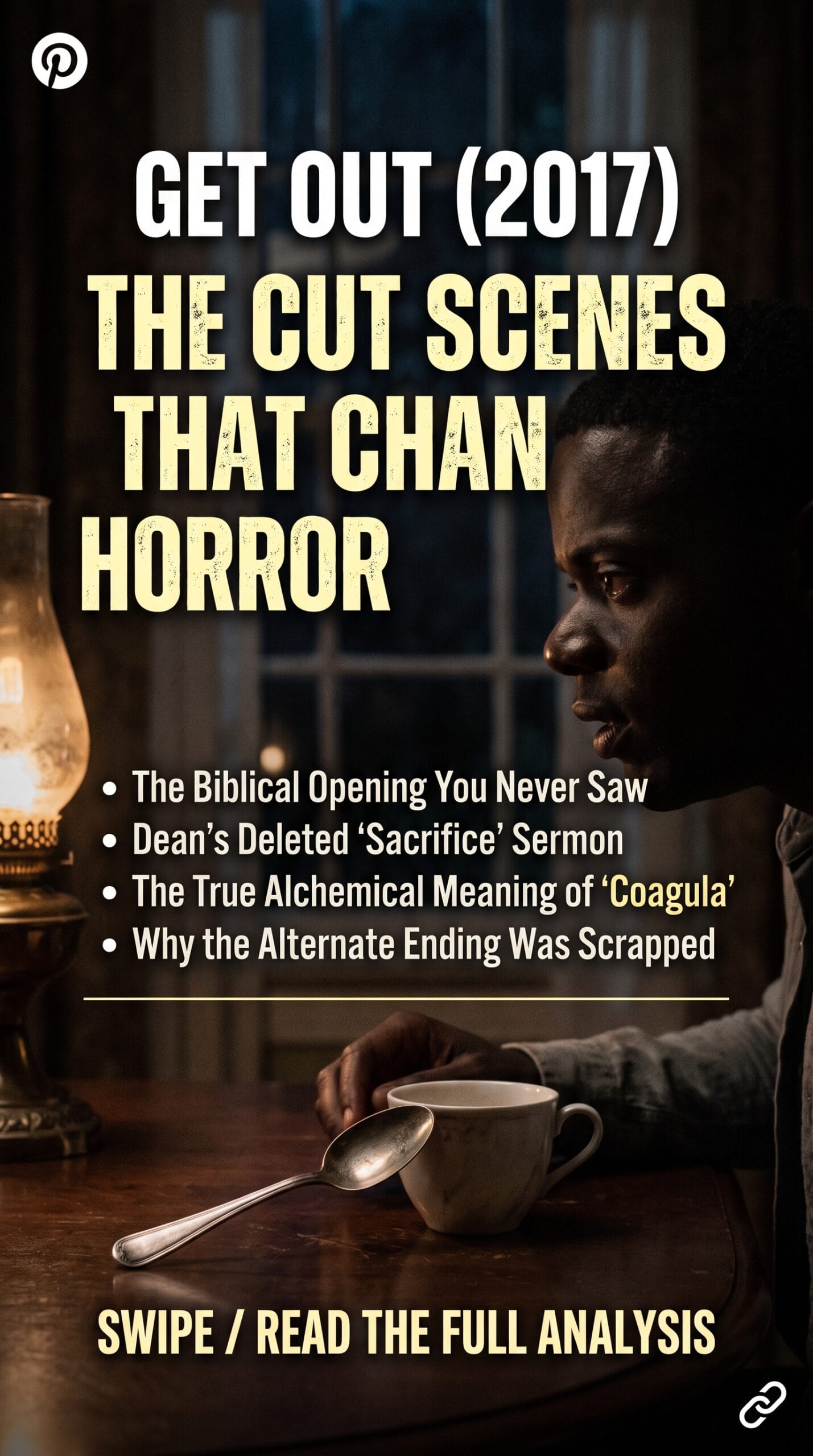
Get Out (2017) hidden details live in the gap between what Jordan Peele wrote and what actually reached the screen.Jordan Peele’s shooting draft of
Get Out (2017) opens on a page you will never see projected: a line from Romans, printed cold before a single frame exists. “I appeal to you therefore, brothers, by the mercies of God, to present your bodies as a living sacrifice.” Then Andre Hayworth starts running down a suburban street, and the movie you know begins. What sits between that verse and the theatrical cut is the most interesting text I’ve read in months, because it isn’t really a deleted scene.It’s a set of decisions, made and then unmade, and you can watch Peele’s whole argument sharpen in the gap between them.I had both a full draft screenplay and the subtitle transcript for this one, which meant I could do something I rarely get to do cleanly: line the script up against exactly what survived to the audio track, sentence by sentence, and see precisely where a knife went in. Some of what I found is well documented — Peele has talked publicly about the ending he shot and un-shot. Some of it, as far as I can tell, has never been written about, because it only exists in a draft, and drafts don’t get quoted in oral histories.I’m going to walk through both kinds, because together they make an argument the film itself is too polished to state directly: nothing in
Get Out survived by accident, and the things Peele cut are as instructive as the things he kept.
The Sermon Before the Party
The draft opens not on Andre alone but intercut with the Shaw family at dinner — a different white family than the Armitages, watching Andre through their bay window without reacting, while their son Joshua asks an unrelated question about Disney World. “Tony said that Mickey is not really Mickey; it’s someone else in there,” the boy says.His father corrects him: “Mickey’s Mickey.” It’s a throwaway kid’s line about a costume character, delivered in a scene that never made the cut, and it is also, structurally, the entire plot of the movie stated eleven pages before you’re supposed to know it. A body that isn’t who it appears to be. A family that finds this unremarkable enough to discuss over dinner while a man dies on their lawn.None of it is in the film you’ve seen. I read the subtitle transcript against the script line by line, and the theatrical cut simply starts with Andre, alone, irritated, talking to himself about street names — no Shaw family, no Mickey, no dinner table.Peele has spoken publicly about an even earlier version of this opening, set at Disneyland itself, which he scrapped because, in his words, “the tone of that was just off for my brand of horror.” What I found in this draft is a different, later attempt at the same problem — softer, quieter, still built around a family so used to their own arrangement that atrocity registers as background noise. He cut that one too.What’s left is just Andre, alone in the dark, which turns out to be scarier than any amount of scene-setting, because loneliness is the actual subject of the film, and Peele apparently figured out you demonstrate that by removing company, not by adding irony.
The Speech Dean Doesn’t Get to Give
Here’s the Get Out hidden detail that surprised me most. In the draft, right before Chris goes under for the last time, Dean Armitage delivers what can only be described as a sermon. He stands at the fireplace and works himself into what the stage direction calls “tears of joyous madness”: fire as a reflection of mortality, the sun as a god who will also die, “we baptize ourselves in the firewater,” and finally, screaming, “I’m saying that we’ve found OUR PURPOSE!!! There must be a sacrifice! Sacrifice is essential for the righteous to achieve their true potential.A vessel must be comprised. A host must be born!!!”That word — sacrifice — is the same word from the Romans epigraph on page one. Present your bodies as a living sacrifice. Dean’s whole unhinged monologue is the family’s twisted liturgy, restating a verse about surrendering yourself to God as a mandate for harvesting somebody else’s body instead. It’s a genuinely disturbing piece of writing on the page, and it’s completely absent from the film.I checked the subtitle transcript across the entire sequence — Chris looking for the keys, Dean’s “what is your purpose” question, Rose’s stall, the fall into the Sunken Place — and the sermon simply isn’t spoken. In the released cut, Dean asks his one question, Missy clinks her spoon, and Chris goes under almost silently. No fire. No baptism. No host must be born.My best guess: it got cut for explaining too much, the kind of clarity a film like this can’t afford once it’s already trusted its audience to feel the fear without a rulebook. The draft’s Dean wants you to understand the theology. The film’s Dean just wants you to disappear. Missy’s teacup does more work with less noise than Dean’s whole religious collapse, and somebody in that editing room clearly figured that out.
What “Coagula” Actually Means
The procedure itself is named onscreen — Roman Armitage calls it “the Coagula” in his videotaped pitch, presented as something the family invented. It isn’t.
Solve et coagula is real alchemical Latin, centuries old, meaning roughly “dissolve and combine” — the instruction at the center of the entire alchemical tradition, the idea that you break a substance down to its base elements before recombining it into something purer. Jim Hudson’s brain is the substance being dissolved. Chris’s body is what it’s recombined into.The Armitages borrowed a word that’s described exactly this kind of magical thinking since the Middle Ages — the fantasy that you can take something apart and reassemble it as something better, cleaner, more valuable, with no moral residue left over from the thing you started with. Jim even talks about it that way in his hospital-bed monologue, calling it “a man-made miracle,” which is alchemy’s oldest promise with “man-made” doing the work “God-made” used to do.
The Deer, Twice
Chris and Rose hit a deer on the drive up, and Chris — over Rose’s indifference — walks into the woods to check on it, gasping, wet-eyed, watching it “with a black wet eye,” per the script’s own description. Dean’s reaction at the house minutes later is to call deer vermin: “I don’t like the deer. I’m sick of it. They’re taking over. They’re like rats.” It sounds like a rich man’s mild eccentricity.“Buck” has a specific, ugly history as a term for Black men in America, and Dean’s hatred of the animal reads very differently once you clock what the family actually does to Chris a few scenes later — a mounted deer head, antlers and all, sits directly above the chair he’s strapped into. The film wants you to notice the trophy room before you notice what kind of trophy Chris is about to become.But the deer does one more piece of work that gets missed even by people who catch the buck reading, because it requires holding two scenes in your head sixty pages apart. Missy’s hypnosis drags out of Chris the fact that his mother died of a hit-and-run — that she survived the initial impact and lay on the roadside for hours because nobody went looking. Near the end, fleeing the house, Chris hits Georgina with the car. Unlike every adult in his mother’s story, he stops. He gets out.He puts her in the passenger seat instead of driving away, even though — he doesn’t know this yet — she’s about to claw his face open a moment later. It’s the same accident, restaged, with Chris finally playing the part nobody played for his mother. The film never states this connection. It just lets you hit the deer in act one and hit a person in act three and trusts you’ll feel the rhyme before you can name it.
Cotton, as a Plan
The detail I keep coming back to, the one that made me sit back from the screen the first time I understood it, is the cotton. Strapped into the chair, waiting for Missy’s spoon to send him under, Chris tears the stuffing out of the chair’s ripped upholstery and packs it into his own ears — a homemade set of earplugs against a hypnotic cue built entirely on sound. It works. He fakes the trance.It’s the single smartest thing anyone does in the entire film, built by hand from the ugliest material history could have handed him — about as clean a thesis statement as a horror film has ever smuggled into a prop. Slavery’s most exhausted visual shorthand — a Black man’s hands and cotton — gets inverted into the one act of resistance the film allows him before the violence starts. As one close reading of the scene puts it, this might be the only time a Black man picking cotton has been a lifesaving task.
Get Out (2017) Hidden Details: The Shoebox
Rose keeps a box in her closet, and inside it are photographs of Rose with other Black men — Walter is one of them, Georgina is another, confirmed present in the released film. In the shooting draft, that box is annotated like a scrapbook: Christmas 2014, Memorial Day 2013, and at the bottom, older than the rest, Thanksgiving 2009 — Rose kissing Walter’s cheek, except in the photo he isn’t wearing the vacant, borrowed smile he wears now. That date is script-only; the film doesn’t linger on it long enough to read off the screen.What the film does keep is the pattern itself, and the math it implies: whatever’s happening to Chris this weekend isn’t something the family improvised. It’s routine, dressed up each time as a new romance, a new “Chris, these are my parents.” Rose isn’t a lure the family deploys. Rose is the mechanism itself, and the box is the only place the film lets that mechanism’s history sit in plain view, for exactly as long as it takes Chris to find it before she catches him looking.
What Jim Hudson Actually Wants
Jim Hudson gets the film’s most quietly devastating line, and it isn’t the one people usually quote. Everyone remembers “I want your eye” — the blind art dealer who submitted to
National Geographic fourteen times before giving up on his own vision, literally and otherwise, telling Chris he wants “those things you see through.” What gets skipped is the line right before it, where Jim insists, with what reads as complete sincerity, that he doesn’t care what color Chris is — “black, brown, green, purple, whatever” — because what he wants is “so much deeper.”It’s the most articulate version of the film’s whole argument, delivered by the character who seems, on the surface, least like a monster. Jim genuinely believes he’s after something purer than the crude race talk Dean and the party guests traffic in — talent, vision, an eye that can find “the beauty in abandoned things,” which is literally how Chris describes his own photography a few pages earlier.Jim wants the output of Chris’s Blackness — the specific way it shaped how Chris sees, what he’s drawn to, what he can do with a camera — while discarding the part of Chris that produced it. Call it racism in its most sophisticated disguise: appreciation with the person subtracted out. Every party guest at the Armitage estate wants Chris’s body. Jim is the only one honest enough to admit he wants something that sounds, to himself, like flattery.
The Sunken Place, In Peele’s Own Words
Peele explained the Sunken Place himself, on social media, not long after release, in language plainer than most of the film’s critics managed: “We’re all in the Sunken Place.” And more specifically: “The Sunken Place means we’re marginalized. No matter how hard we scream, the system silences us.” It’s worth sitting with how literal that staging actually is — Chris paralyzed, screaming, watching his own eyes from a theater seat a thousand feet below the version of himself other people are allowed to see and hear.The metaphor doubles as the premise itself, rendered directly into production design: a place where your interior life is fully intact and fully unreachable, and the only proof anyone has that you’re still in there is a single tear running down a face that isn’t taking any instructions from you anymore.
The Ending That Never Reached You
And then there’s the piece of this film’s history that’s genuinely public record, though most audiences who saw it in theaters never knew it existed. The ending Peele shot first had no Rod in the driveway. A real police officer pulls up. Chris is arrested for the deaths at the Armitage house, and the film’s final scene is a prison visiting room, Rod across the table, Chris smoking a cigarette, telling him — with something close to peace — “I’m good, man. I stopped it.” Then guards walk him back to his cell.In the draft I read, Chris doesn’t kill Rose in the climax at all — it’s Jeremy who dies on the lawn, shot by accident by his own grandfather’s borrowed body, with Rose nowhere near the final struggle. What actually reached theaters is a different animal, one where Rose herself is shot and dying, still trying to manipulate Chris with “it’s me, and I love you” while he has his hands around her throat — a line confirmed word-for-word in the theatrical subtitle track — before headlights save him instead of handcuffs.Producer Sean McKittrick told Vulture exactly why the ending changed: “We tested the movie with the original ‘sad truth’ ending where, when the cop shows up, it’s an actual cop and Chris goes to jail. The audience was absolutely loving it, and then it was like we punched everybody in the gut.” He put the timing in plain terms too: “The country was different.We weren’t in the Obama era, we were in this new world where all the racism crept out from under the rocks again.” It’s worth noticing what that decision costs the film even as it makes the theatrical cut more bearable to sit through. The prison ending argues that surviving individual monsters means nothing if the system waiting outside the house is a bigger, slower version of the same machine. The Rod ending argues that this time, help arrives in time.Both endings are honest about different things, and Peele decided, correctly I think, that 2017 had enough true stories ending the first way already.
The Design Behind the Scares
What strikes me most, having read all three versions of this film at once — the biblical epigraph nobody sees, the sermon nobody hears, the prison cell nobody visits — is how little of the finished film’s power actually depends on any of it. Missy’s teacup already told you everything Dean’s monologue would have spelled out. Andre’s loneliness in that first scene did the same work the Shaw family’s dinner table was built to do.Every deletion I found makes the same argument twice: once by what it says outright, and once, more quietly, by proving Peele trusted the shorter version to say it better. It’s a film that got rewritten, cut, and rewritten again until the metaphor was the only thing left standing.Taken together, these are the Get Out (2017) hidden details that never survived contact with the final cut.
Frequently Asked Questions
What is the alternate ending of Get Out?
In Jordan Peele’s original ending, a real police officer arrests Chris for the deaths at the Armitage house, and the film closes on Chris in prison. Test audiences reacted so strongly that Peele shot the theatrical version instead, where Rod arrives to save Chris rather than the police.
What does the Sunken Place mean in Get Out?
Jordan Peele has explained
the Sunken Place directly: it represents marginalization, a state where a person’s inner voice and will are real but completely unreachable by anyone else, “no matter how hard we scream.”
What does Coagula mean in Get Out?
Coagula references the real alchemical phrase “solve et coagula,” meaning “dissolve and combine.” It describes the family’s brain-transplant procedure as a form of alchemy — breaking one person down to recombine them into another body.
Are There Get Out (2017) Hidden Details in the Deleted Screenplay?
Yes, significantly. Early drafts include a cut opening scene with a second family, an extended religious monologue from Dean before Chris’s hypnosis, and an entirely different, bleaker ending in which Chris is arrested rather than rescued.Sources for the alternate ending and its context:
Slash Film, “The Original Get Out Ending Was Way Darker.”