
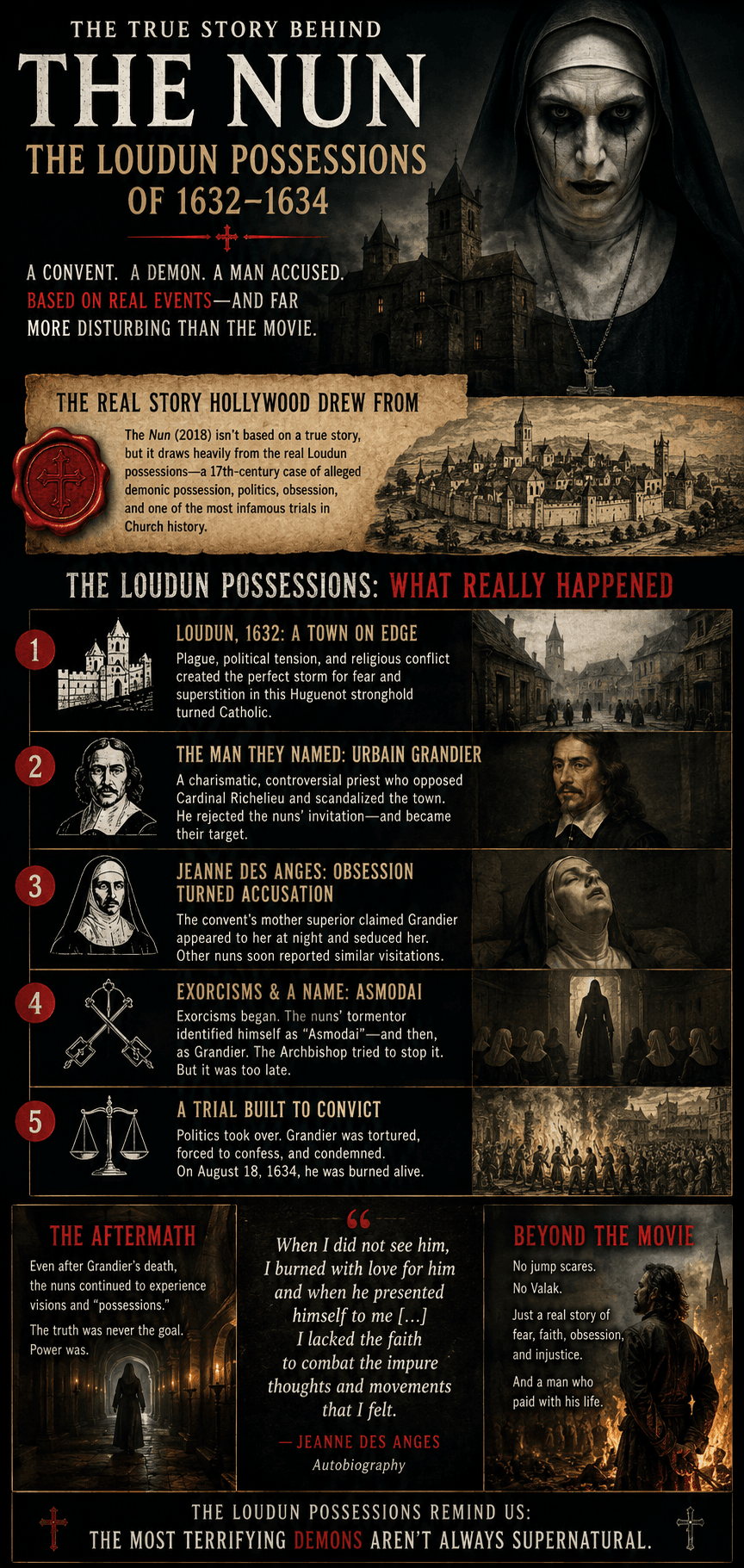
A convent full of young nuns starts seeing things at night. A demon gets a name. A man is blamed. By the time it’s over, he’s dead and the visions are still happening. That’s the plot beat The Nun leans on to open its world, and it’s tempting to assume Hollywood invented the shape of it. It didn’t.
In 1634, in a small walled town in western France, a parish priest named Urbain Grandier was tortured and burned alive because seventeen Ursuline nuns said he had sent devils into their bodies. The Horror Cave’s review of The Nun already says plainly that the film isn’t based on a true story, and that’s still accurate — there’s no direct line from this case to Valak’s screenplay.
But the Loudun possessions are the real historical well that this entire genre of “the Church investigates a haunted convent” keeps drawing from, and the actual story is worse, stranger, and angrier than anything a screenwriter needed to invent.
This is that story, as close to the documented record as four centuries of trial transcripts, sworn testimony, and one nun’s own autobiography allow.
Loudun, 1632: A Town Already on Edge
Loudun was a fortified Huguenot stronghold that had converted, unevenly, back to Catholic control. By the early 1630s it sat in the middle of a very specific political fight: Cardinal Richelieu, consolidating royal power under Louis XIII, wanted the town’s defensive walls torn down. The townspeople, still majority Protestant in sympathy, wanted to keep them. In May 1632, plague swept through the town and killed a large share of its population, leaving behind the kind of collective grief and dread that tends to precede outbreaks of religious mania across early modern Europe.
In the middle of this sat a new Ursuline convent, founded in 1626, housing about seventeen nuns with an average age of twenty-five. Their mother superior was Jeanne des Anges, born Jeanne de Belcier, a baron’s daughter who had entered religious life young after a childhood accident left her with a physical disability. The convent’s spiritual director, Father Moussault, died not long before the visions started. The nuns needed a replacement.
They asked Urbain Grandier.
The Man They Named
Grandier was the parish priest of Saint-Pierre-du-Marché, and by every account that survives, he was hard to ignore. Educated, well-connected, a gifted preacher, and openly arrogant about all three. He’d fathered a child with Philippe Trincant, the daughter of the town’s prosecutor, and the scandal never fully died down. He’d written a treatise arguing against clerical celibacy. And, fatefully, he had publicly sided with the townspeople against Richelieu’s plan to demolish Loudun’s walls — a position that put him crosswise with the single most powerful man in France.
He turned down the convent’s invitation to become their spiritual director. He never knew, at the time, that this refusal would matter, because he never knew that Jeanne des Anges had already become fixated on him.
What Jeanne Wrote About Him, in Her Own Hand
This is the part of the story that rarely makes it into the summary versions, and it deserves to be sat with rather than rushed past. Jeanne des Anges wrote an autobiography later in her life, and in it she described her feelings for Grandier in language that leaves very little to interpretation: “When I did not see him, I burned with love for him and when he presented himself to me […] I lacked the faith to combat the impure thoughts and movements that I felt.”
Shortly after, she reported that Grandier’s spectral image had appeared to her at night and seduced her, taking from her, in her words, what she had vowed to keep for Christ. Other nuns began reporting the same kind of visitations — disturbed nights, ghostly men moving through the halls, including the recently deceased Father Moussault himself.
None of this proves fraud on its own. It’s entirely possible to read it as a devout, isolated young woman experiencing something she genuinely believed was demonic. It’s also possible to read it as the opening move of something else. What’s not in dispute is that the convent’s crisis began with the private obsession of the one woman whose word would carry the most weight in what came next.
The Exorcisms Begin, and a Name Gets Attached
The convent’s chaplain, Canon Jean Mignon, was Trincant’s nephew — which is to say, related by blood to the prosecutor whose daughter Grandier had publicly humiliated. Mignon initiated formal exorcisms. Under questioning, the nuns’ possessing spirits began identifying themselves, one taking the name Asmodai. Within about a week, on October 11, 1632, the nuns named their tormentor: Urbain Grandier, a man several of them, by the convent’s own later admission, had never actually met.
The Archbishop of Bordeaux briefly intervened, had the most disruptive nuns sequestered away from each other, and the possessions quieted. That should have been the end of it. It wasn’t, because by then the case had reached a man who needed it to continue.
A Trial Built Not to Be Overturned
Jean de Laubardemont, a relative of the convent’s mother superior, arrived in Loudun on unrelated business: enforcing the demolition of the town’s walls. He was blocked by armed local resistance. He reported both failures back to Richelieu — the walls and the convent — and by November 1633 he’d been handed formal authority to investigate the possessions. Grandier was arrested and imprisoned.
On May 31, 1634, a royal council decree gave Laubardemont total, unappealable authority over the case, with a 500-livre penalty attached to anyone who tried to challenge it in a higher court. That’s not how a fair trial gets built. That’s how a verdict gets protected in advance.
The exorcisms continued for two and a half months under the Bishop of Poitiers and a Capuchin friar named Tranquille. And on June 23, 1634, the court staged something that’s hard to read as anything other than theater with a predetermined outcome: they forced Grandier — a man who publicly denied that the possessions were even real — to perform the exorcism ritual on the possessed nuns himself, as a “test.”
He didn’t believe in what he was being made to do. They made him do it anyway, in front of witnesses, so his failure could be entered into the record.
What They Did to Him
Among the evidence entered at trial was a written pact, supposedly signed by Grandier himself, binding him to Lucifer, Satan, Beelzebub, and several other named demons in exchange for twenty years of earthly pleasure. It survives today, reproduced in books on witchcraft, written backward in Latin with a scribal hand. Whether Grandier wrote a word of it, whether it was forged outright, or whether it was produced under torture is not settled by the record. What is settled is that a court used a document allegedly signed by demons as evidence against a man, and that document helped kill him.
In August 1634, Grandier was convicted of causing the nuns’ possession through sorcery. His sentence: torture at “the first and last degree” — the maximum the law allowed — followed by burning alive, his ashes scattered to prevent any burial or relics, and a permanent bronze memorial plaque, funded from his own confiscated property, to be displayed in the Ursuline church “for all eternity” as a warning.
The torture was administered with the brodequins, an iron boot fitted around the legs and driven tighter with wedges until bone and marrow gave way. Court records from the period also describe the “extraordinary question” — the water torture standard to French judicial practice at the time, in which a prisoner was forced to swallow measured quantities of water through a horn funnel until the body could hold no more. Both methods existed for the same purpose: to make a confession, any confession, easier to give than to withhold.
Before the torture began, his sentence gave him one out: name his accomplices and the judges might moderate the punishment. Jean de Laubardemont told him so directly. Grandier’s answer, recorded in the proceedings, was that he had no accomplices to name. He held to that through the boot and the water. He never confessed. There was nothing left to give them, and he didn’t give it anyway.
The Fire
He was promised the small mercy afforded most condemned prisoners of the era — strangulation before the flames, so the burning itself would only consume a corpse. That mercy was withdrawn. As he was brought to the stake and tried to speak to the crowd, monks standing near him threw holy water in his face specifically to drown out whatever he was trying to say. One of his own exorcist-tormentors, a friar named Lactance, worked up by the crowd’s jeering, lit the pyre before the strangling cord could be pulled tight.
Urbain Grandier burned alive in front of more than six thousand people. He was accused, tried under a court explicitly barred from appeal, tortured by men who thought their faith made the torture more effective, and killed in a way more painful than the sentence technically called for, because a crowd wanted a show and got one.
The Part the Story Isn’t Supposed to Have: It Didn’t Stop
Here’s where the case stops looking like a witch trial and starts looking like something closer to a diagnosis. If Grandier had actually been the source of the nuns’ possession — if the entire premise the court convicted him under was true — then his death should have ended it. It didn’t. The possessions at Loudun continued for another three years, until 1637.
Jeanne des Anges, the woman whose private obsession had opened the whole case, became the possessions’ central performer for the rest of the decade. She reported a cross bleeding on her forehead for three weeks in 1635. She later toured with what she presented as physical evidence of her exorcism — the names “Joseph” and “Mary,” supposedly appearing on her skin as the last demons left her body.
She met Cardinal Richelieu in person. She met the King. The convent that had destroyed a man for allegedly causing this became, for a few more years, something closer to a traveling attraction built around the same woman’s continued suffering.
Richelieu, for his part, had gotten what he actually needed out of the entire affair. Grandier, the walls’ most vocal defender, was gone. The demolition proceeded without him.
What Historians Actually Think Happened
Nobody serious has argued, for a very long time, that Loudun was a straightforward case of a priest summoning real demons. The debate has always been about which non-supernatural explanation fits best, and it’s been argued for almost four hundred years.
John Locke visited Loudun himself decades later, in 1679, and came away calling the entire episode a contrivance — his word — engineered by Richelieu to eliminate a political enemy under cover of religious panic.
Later historians, including Michel de Certeau, have read the nuns’ symptoms through the lens of psychological and mass hysteria: isolated young women, recently traumatized by plague, in a religious culture that had no other vocabulary for female sexual and psychological distress beyond possession. Aldous Huxley’s 1952 book The Devils of Loudun — still the most influential single account of the case — leans into Jeanne des Anges’s documented obsession with Grandier as the actual origin point, with Mignon’s exorcisms and Laubardemont’s ambition doing the rest of the work once the fire was already lit.
A different, older reading, from the historian Antoine-Jérôme Calmet, frames the whole thing as instigated for coldly political reasons from the start, with the nuns’ visions as a convenient tool rather than the trigger.
These explanations don’t fully agree with each other. What they agree on, without exception, is that Urbain Grandier didn’t do it.
Where This Sits Next to The Nun
The Horror Cave’s own coverage of Valak already lays out how the demon’s mythology in the Conjuring Universe is an invented layer built on top of genuine Catholic exorcism iconography — a manufactured “true” pedigree built to serve a franchise’s marketing rather than any actual documented case.
Loudun is the inverse of that: a fully documented case, with trial records and a sworn confession in the possessed woman’s own hand, that got run through the same institutional machinery — a Church investigation, a public exorcism performance, a demon with a name — a century and a half before any of this fiction existed. The Nun didn’t borrow this story. It didn’t need to. The iconography was already sitting there in the historical record, waiting for someone to point a camera at a convent hallway.
What Loudun actually offers isn’t a source text. It’s a reminder that the machinery the genre finds so cinematic — robed men, a possessed woman naming her tormentor, an institution absolutely certain it knows what it’s looking at — has a body count when it’s real. Grandier’s body count was one man, burned alive, for a set of walls a cardinal wanted torn down.
The case has outlived every one of its participants by centuries, and not because anyone still believes in Asmodai. Aldous Huxley’s 1952 book The Devils of Loudun turned the trial into the definitive modern account and is still the version most people encounter first.
Ken Russell adapted it into a 1971 film built on Huxley’s book and John Whiting’s stage play, with Vanessa Redgrave playing Jeanne des Anges as a woman closer to tragic than villainous. Krzysztof Penderecki wrote an opera around her in 1969, revived and restaged as recently as 2022. Four hundred years on, artists keep returning to the same two people: a priest destroyed by a case built to be unwinnable, and a nun whose private longing became a nationwide performance she couldn’t stop even after the man she’d named was ash.
The Nun (2018) True Horror: Quick Answers
Is The Nun based on the Loudun possessions?
No. The Horror Cave’s review of the film already establishes that The Nun isn’t based on a true story, and that holds here too — there’s no documented link between the Loudun case and Gary Dauberman’s screenplay. Loudun is a separate, much older piece of real history that happens to share the same basic shape: a convent, a possession, an institution that decides who’s to blame.
What happened to Urbain Grandier?
He was convicted of causing the Loudun nuns’ possessions through sorcery, tortured with the brodequins under a court that had been given unappealable authority in advance, and burned alive in front of a crowd of more than six thousand people on August 18, 1634. He never confessed and named no accomplices.
Did the Loudun possessions actually stop after Grandier’s execution?
No. They continued for roughly three more years, until 1637, with Jeanne des Anges as the central figure. That continuation is one of the main pieces of evidence historians point to when arguing the case was never really about Grandier at all.
Did anyone believe Jeanne des Anges was faking it?
Contemporaries were split, and historians still are. Some readings treat her as a genuine sufferer of psychological distress she had no other framework to describe. Others, following Aldous Huxley’s account, treat her documented obsession with Grandier as the case’s actual origin point. Either way, her own autobiography records feelings for him that predate any of the reported visions.