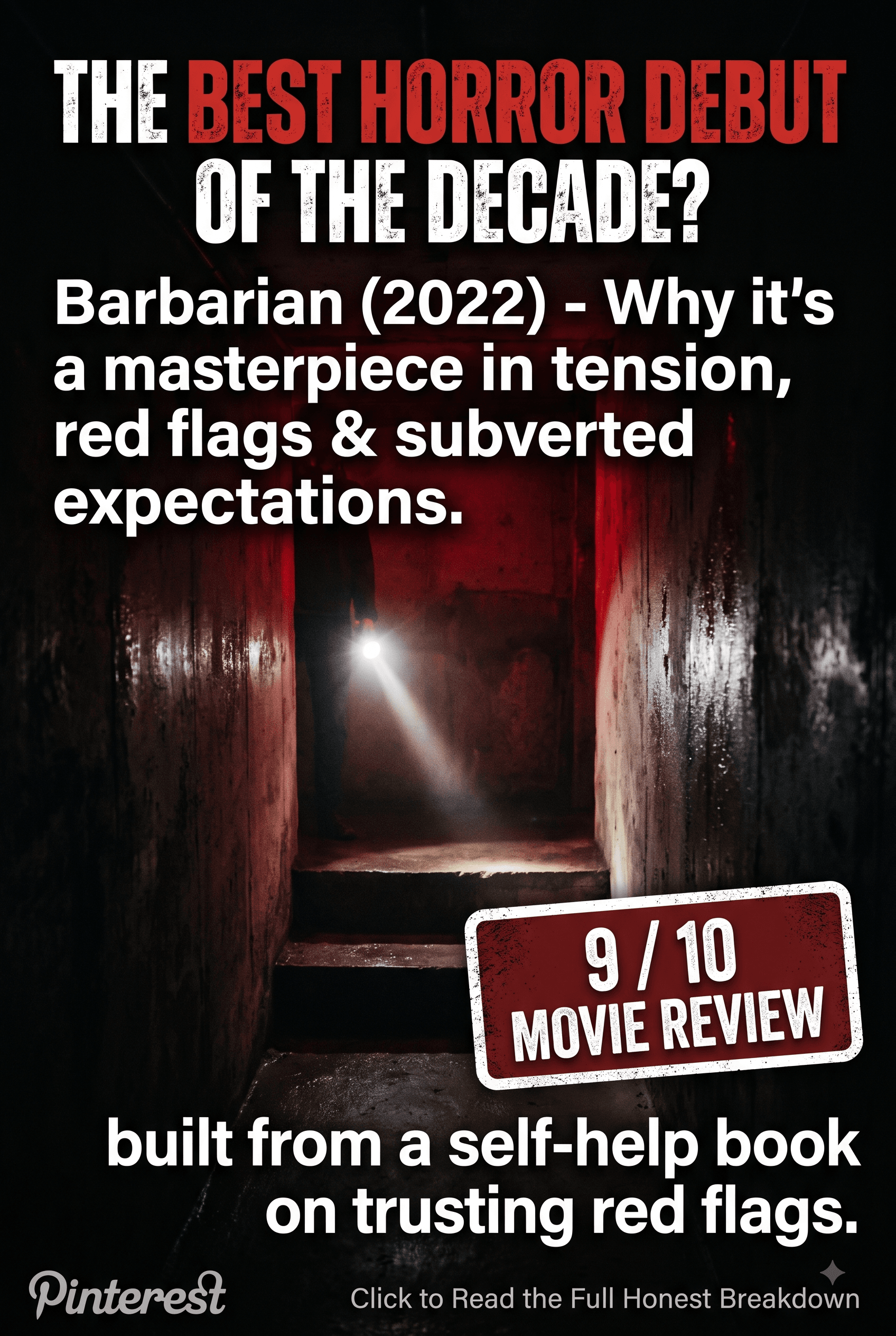
This Barbarian (2022) review starts with a confession: Zach Cregger built the film out of a self-help book, and I mean that as the highest compliment I’ve paid a horror film in the last five years.
Somewhere in the writing process he was reading Gavin de Becker’s The Gift of Fear, the 1997 book that spends a chapter telling women to trust the specific small red flags men throw off in ordinary interactions — the unasked-for compliment, the favor nobody requested, the touch that lands a half-second too long — and instead of nodding along and moving on with his life, Cregger sat down and tried to write a thirty-page scene that packed in as many of those red flags as a single premise could hold.
A woman shows up to a rental house late at night. It’s been double-booked. A stranger is already inside, offering tea, insisting it’s fine, insisting she come in out of the rain. Every instinct in the audience is screaming the same thing her instincts are screaming, and Cregger built the entire architecture of his film around the gap between what she should do and what politeness, exhaustion, and thirty years of being told not to make a scene actually let her do.
That’s the premise. It is not, structurally, where the film ends up, and the distance between where it starts and where it lands is the whole reason I’m writing this review instead of a two-paragraph blurb.
I’ll say the position up front because I don’t believe in making people wait for it: this is the best studio-adjacent horror debut of its decade, and I’m including Hereditary in that sentence.
Cregger — a comedian by training, a founding member of the sketch group The Whitest Kids U’ Know before he’d ever directed a horror film — took a haunted-house premise, split it across two timelines forty years apart, handed the back half of the story to a man the film spends its first act training you to be afraid of, and somehow never once loses the thread of what the movie is actually arguing. That’s an absurd number of plates to keep spinning. He keeps them spinning.
Start with the casting, because Cregger’s smartest decision in this entire production happened before a single frame was shot. Bill Skarsgård plays Keith, the stranger already in the house when Tess arrives, and Cregger has said outright that the casting was the point: horror audiences know exactly what Skarsgård did in It, and the film spends its opening act letting that knowledge do the work no line of dialogue could. Keith is soft-spoken, apologetic, makes tea, offers the couch.
Every ounce of civility reads as performance because the actor delivering it played Pennywise, and Cregger knows you know that, and he uses it as a loaded weapon he never actually fires. The reveal that Keith is exactly as harmless as he looks lands as a small act of cruelty aimed at the audience’s own genre literacy — you distrusted a nice man because of a role he played in a different movie, and the film wants you to sit with that for a second before it takes the real threat and drops it on you from somewhere else entirely.
Justin Long gets the harder job, and he’s the reason the film’s back half works at all. Cregger originally wrote AJ for Zac Efron, and when Efron passed, he rebuilt the part from scratch around what Long could do that Efron couldn’t: play a man whose whole personality is a costume he’s worn so long he’s forgotten it’s removable. Long has spent two decades being the industry’s default harmless guy, the funny best friend, the Mac in the Apple ads, and he cannibalizes every inch of that goodwill here.
He’s described his own approach to AJ as playing a narcissist, and named the men on reality dating competitions as his mental shorthand — guys who treat warmth as a negotiating tactic rather than a feeling. Watch the phone call where AJ hears he’s been dropped from his show over a rape allegation: Long plays it as pure inconvenience, an errand interrupting his afternoon, nothing close to outrage or grief.
That’s a genuinely difficult note to hit without tipping into cartoon villainy, and Long threads it so precisely that by the time AJ does something unforgivable on that water tower, it doesn’t feel like a character breaking. It feels like a mask finally coming off on schedule.
And then there’s Georgina Campbell, who is doing the most thankless job in the film and doing it so well that it’s easy to underrate. Tess has to be the audience’s rational anchor through ninety minutes of increasingly insane circumstances, which usually flattens an actor into one register of “scared” for the whole runtime. Campbell finds something sharper to play instead.
She’s said she was chasing something closer to Daniel Kaluuya in Get Out — grounded, alert, never performing fear for the camera’s benefit — and it shows in the smallest choices: the half-second calculation before she gets back in the car, the specific way she keeps talking to a threat instead of running, because talking has kept her alive in situations like this before and running hasn’t always worked.
Campbell won a BAFTA in 2015 for Murdered by My Boyfriend, played a supporting role in Broadchurch‘s final season, and turned up in Black Mirror’s “Hang the DJ” before landing her first genuine horror lead in 2021’s All My Friends Hate Me — a slow-burn paranoia piece that asked for exactly the kind of quiet, internalized dread she brings here. There’s a version of that same unglamorous, unadorned realism running through Tess.
She’s played as someone whose survival instincts are just correct, over and over, rather than as a final girl hitting beats audiences recognize from other movies, in a film that spends its entire runtime punishing every other character for having worse instincts than hers.
The craft holds up its end of the argument too, which matters more than critics usually give it credit for in horror. Cinematographer Zach Kuperstein shoots the tunnels beneath the house like he’s filming the inside of something alive — narrow, wet, lit almost entirely by whatever light source the characters happen to be carrying, so the audience’s ability to see anything at all is always one dying flashlight away from total blackness. Then the film cuts to 1980s Michigan and the palette does a complete reversal: bright, flat daylight, a garden hose running, a neighbor grumbling about property values.
It’s the least threatening visual register available, and Cregger deploys it specifically for the scenes involving a man loading a trunk with supplies for a home birth that isn’t what it appears to be. That contrast functions as the whole thesis rendered in lighting choices — proof that horror can run entirely on daylight, on sprinklers and trunk space and a neighbor’s idle complaint, as long as nobody looks closely enough at what the daylight is hiding.
Composer Anna Drubich makes the correspondingly smart choice to mostly get out of the way. The film’s biggest scares run on near-silence — footsteps, breathing, the clatter of a dropped object on concrete — and Drubich saves the actual score for the moments that need emotional scaffolding rather than adrenaline, which is a much harder instinct to trust than wall-to-wall stinger cues. When the film finally does reach for a needle drop, it’s the Ronettes’ “Be My Baby” playing over the credits after Tess walks away from the one creature in the entire story who wanted something from her honestly.
A 1963 pop single built entirely around the word “baby,” closing out ninety minutes about what happens when that same want gets engineered by a predator instead of felt by a person. It’s the kind of needle drop that reads as a punchline for about five seconds before it reads as grief instead.
None of this works, though, if the film is only interested in being clever, and I want to be honest about where I think Barbarian comes closest to tripping over its own ambition.
The 1980s flashback structure asks a lot of patience from an audience that showed up for a haunted rental house, and there’s a stretch in the middle where the film is juggling two timelines, three tonal registers, and a small essay’s worth of subtext about Brightmoor, Detroit, and the specific kind of urban abandonment that lets a predator operate undisturbed for decades — and for about ten minutes, before the water tower sequence snaps everything back into focus, I could feel the film daring me to lose patience with it. It never quite loses me.
But it gets closer to the edge than a film this confident probably needed to.
That confidence, though, is the whole reason the movie works as well as it does. Critics circling Barbarian on release kept reaching for the same handful of words — gentrification, toxic masculinity, taking responsibility — and they weren’t wrong, but I’d argue the film’s real subject is narrower and sharper than any of those words suggest on their own. It’s about what happens when decades of unsupervised privilege — a house, a neighborhood, an industry, doesn’t matter which — finally gets asked to account for what it quietly manufactured, and comes up with nothing.
Frank built a monster out of decades of privacy and an emptied-out block that nobody was watching. AJ built a persona out of an industry that rewards a certain kind of charm and never asks what the charm is covering for. Both men get confronted by the consequences of what they made, in the same underground room, in the same forty-eight hours, and the film doesn’t need to underline the parallel because it’s already standing right there in the blocking. I’ve broken down exactly how that confrontation plays out, water tower and all, in our Barbarian (2022) ending explained piece.
Barbarian cost roughly $4.5 million and made more than ten times that back, a number I mention not because box office validates art but because it’s proof that audiences will follow a film that trusts them to keep up with a structure this unconventional. It sits at 92% on the Tomatometer, against 212 counted reviews, against a noticeably cooler 70% from audiences, which tells you almost everything about how the film’s confidence plays.
The consensus summary on Rotten Tomatoes calls it “smart, darkly humorous, and above all scary” — a description that undersells how rare it is for a horror film to earn all three adjectives in the same sentence without one of them cannibalizing the others. Critics who watch a lot of horror recognized exactly how rare this level of control is, while some portion of the general audience walked in expecting a haunted-house movie and got handed a small treatise on complicity instead. I understand that reaction even as I disagree with it.
A film owes its audience the best possible version of whatever it’s actually trying to be, not the movie they walked in expecting, and on that measure Barbarian barely puts a foot wrong.
Cregger has said he didn’t outline this one — that he wrote it trying to follow the story the way an audience member would, discovering the turns as he went rather than architecting them in advance. I believe him, and I think it’s the reason the film feels alive in a way that a lot of carefully engineered horror doesn’t. There’s a looseness underneath the control, a sense that Cregger is genuinely curious what happens if he keeps pulling this thread, and that curiosity is contagious in exactly the way good horror is supposed to be.
I walked out wanting to watch it again immediately, which happens to me maybe twice a year, and I’ve now watched it three times specifically to write this review, and it hasn’t given up anything on the third pass that it wasn’t already offering on the first. That’s not a small thing. Most horror films that rely on structural surprise become inert once the surprise is spent. This one keeps working because the surprise was never really the point.
Ethan’s Score: 9 / 10
I keep thinking about that thirty-page exercise Cregger set for himself — how many red flags can one scene hold — and how the finished film ended up being about something bigger than the exercise that started it. It’s rare that a movie built from a gimmick this specific earns the right to mean something this much larger than its own premise. Barbarian earns it in every direction I can find to look.
Barbarian (2022) Review: Quick Answers
Is Barbarian (2022) Worth Watching?
Yes. This Barbarian (2022) review lands on a 9/10 for good reason: the film holds a 92% Tomatometer score against a cooler 70% audience score precisely because it trusts viewers to follow a structure most horror films wouldn’t attempt, splitting one haunted-house premise across two timelines and a cast working against their own public reputations.
How Much Money Did Barbarian (2022) Make?
Barbarian cost roughly $4.5 million to produce and earned over $45 million worldwide theatrically, a return of more than ten times its budget. That performance came without a major studio marketing push, largely on word of mouth about a film critics and audiences agreed was worth the risk of going in blind.