
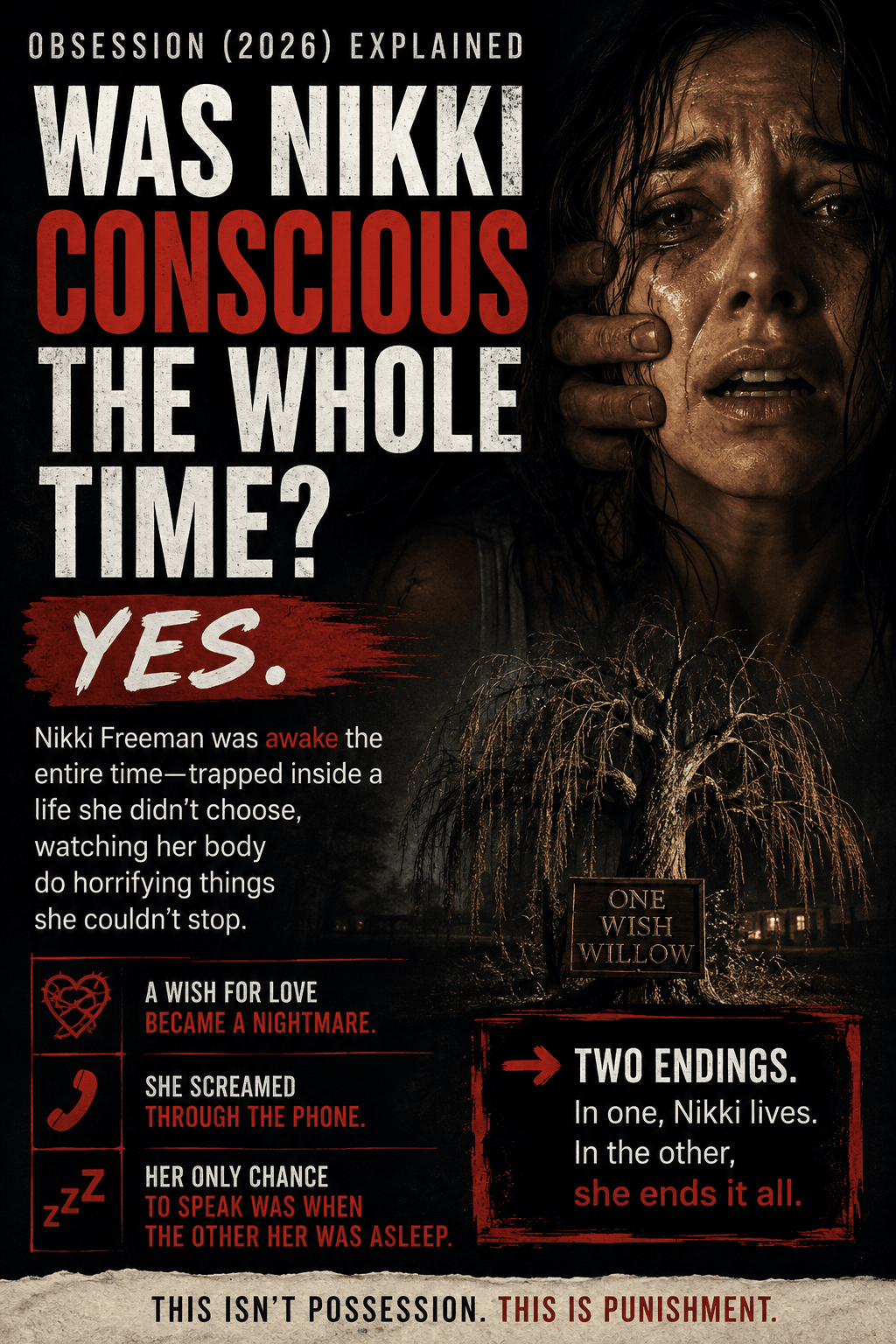
Was Nikki conscious in Obsession the whole time? Yes. Director Curry Barker has said as much directly: the real Nikki Freeman was awake behind her own eyes for the entire runtime of his 2026 supernatural horror film, trapped inside a body a stranger’s wish had taken from her, and only a handful of times able to fight her way back to the surface.
That single detail changes what kind of movie this is. Every act of violence the audience watches Nikki commit is something a fully present woman experiences from the inside, unable to close her eyes or move her own hands.
Barker has confirmed he shot two versions of the film’s final scene. In the one that exists, Nikki lives. In the one that doesn’t, she completes her own suicide before the curse ever breaks.
“The original ending, she just ends it all,” Barker told MovieWeb. The people around him talked him into using the survival take instead, because it read as the crueler outcome: a fully conscious woman forced to keep living with what her body did while she watched.
Was Nikki Conscious in Obsession the Whole Time?
Barker has said in press and post-screening Q&As that this was never meant to read as a possession story in the traditional sense. The wish manufactures an entirely new persona out of Nikki’s own materials, one that hijacks her body completely while the real woman is shoved into the passenger seat of her own mind, present for every second of it.
It’s worth separating this from the genre’s usual shorthand. A possession story typically imports something from outside — a demon, a spirit, an entity with its own name and history. Obsession is closer to the old monkey’s paw structure, where the wish reads intent rather than words, and grants exactly the horrifying, literal version of what was asked for.
Bear didn’t ask for a demon to move in. He asked for total devotion, and the wish built him a woman incapable of offering anything else, using Nikki Freeman’s own body as the raw material.
Horror has used the monkey’s paw structure for a century to punish the person who made the wish. What’s colder about Obsession is that it punishes the person the wish was made about instead, and takes its time doing it.
There’s a scene, played in the trailer before anyone knew what it meant, where Bear calls the One Wish Willow customer service line looking for a way to undo what he did. The person on the other end asks if he wants to speak to Nikki. What comes through the phone afterward is her screaming — proof, Barker has confirmed, that her real self has been present the entire time, in whatever limbo she’s been shoved into underneath the surface.
It’s a strange thing to bury inside a marketing trailer months before release: the clearest evidence for the film’s whole thesis, sitting in plain sight, mistaken by most first-time viewers for a jump scare rather than a confession.
She only gets loose when the persona wearing her is asleep. There’s a scene, quiet compared to everything around it, where Bear tries to sneak out of the house at night. A whisper stops him. It’s her, using the sleeping body’s mouth: “Kill me, Bear. Please.” He asks if it’s really her. “She’s sleeping,” the voice says. “It’s me.”
He does nothing with it. Too ashamed to hold her gaze, he goes back to bed. The one moment Nikki Freeman gets to speak to Bear with her own unfiltered voice, and what she asks for is to be put out of a suffering nobody around her will name.
Who Nikki Freeman Was Before the Wish
Before any of this, Nikki works the register at Mandy’s Music with Bear, Ian, and Sarah. She’s writing a novel and wants out of retail — she hasn’t figured out toward what yet, but she’s restless in a way that reads as someone reaching for a life bigger than the one she’s living.
That’s its own kind of freedom the film doesn’t let her keep.
She’s the one who calls Bear to make sure he’s coming out on his day off. In the car once, she asks him point-blank if he likes her, and he’s too frightened of the honest answer to give her one — which is the moment he reaches for the One Wish Willow instead of his own nerve.
Sarah tells Bear that Nikki used to describe him as basically a brother, someone the idea of dating made her a little sick to think about. It’s possible that’s true. It’s also possible Nikki was softening things for her audience — Sarah has her own unspoken thing for Bear, and people rarely hand over the whole truth about a crush to someone competing for the same one.
She’s also sleeping with Ian, casually, the way two friends do when neither wants to name it. Sarah lays it out for Bear in the front seat of her SUV, seconds before Nikki puts a brick through the driver’s window: “Nikki and Ian have been hooking up on and off for like two years. It’s super chill, and not romantic.”
That’s the last thing Sarah ever explains to anyone.
Bear buys the Willow and, half-joking, wishes that Nikki Freeman would love him more than anyone else in the world. He tells himself he doesn’t believe it will work. He watches it work anyway, and instead of undoing it, he starts testing it — fishing for confirmation with pointed little questions about whether she’s happy, whether she means it, whether any of this is real.
The film is clear about who authored this. Bear did. Every horror that follows belongs to him first, and Nikki Freeman is the one who has to live inside it.
Curry Barker’s path here is not the usual one. He built an audience making short-form comedy online before financiers trusted him with a horror feature, and it shows in how confidently the film swings between the party-scene punchlines and the material that follows them. Obsession is his theatrical directorial debut. Going by the box office, it will not be his last horror film.
Obsession premiered at Toronto in September 2025 before Focus Features gave it a wide release the following May, and it became one of the biggest word-of-mouth horror hits of the year — the kind of box office that usually rides on a masked killer or a monster, not on a woman losing access to her own nervous system in front of the person who did it to her.
Audiences showed up for a monkey’s paw movie and left arguing about consent, which tells you something about how well Barker buried the argument inside the scares.
The Moments Real Nikki Fights Her Way to the Surface
Early on, before the persona fully takes hold, she initiates a kiss with Bear, then screams and pulls away mid-moment, her own consciousness apparently snapping back into focus hard enough to frighten them both.
It happens again, worse, later in bed. She’s making the sounds Bear’s wish demands of her, and there are tears running down her face while she does it — the clearest single image the film offers of what’s actually happening underneath the performance: a woman locked out of her own body, still feeling everything, unable to make her mouth say stop.
These moments don’t resolve anything. They’re glimpses, gone as fast as they arrive, and each time the persona reasserts itself a little faster than the last — its own quiet horror, a woman losing ground in the fight for her own body over the course of a single film. By the party scene, later, the breakthroughs have shrunk to a single sentence before the mask slides back into place.
Inde Navarrette is doing a woman doing a puppet doing a girlfriend, three layers stacked in a single performance, and critics noticed. Deadline’s review credits her with lending the film urgency and humanizing choices that could have played as purely mechanical on the page.
The Cat, and What the Wish Actually Wants
Bear’s cat dies early in the film. Post-wish Nikki digs the animal up from where it was buried and arranges it in a candlelit display for him to find.
When that doesn’t produce the reaction she’s chasing, she cooks it and serves it to him as a sandwich. Barker has talked about designing the scene around smell as much as image: “the idea of the smell of the house when she did that.”
The wish has no interior model of another person’s needs to draw from. It performs whatever gesture it thinks devotion looks like, with total confidence and zero understanding, the way a child mimics a funeral without knowing what death means.
If Real Nikki is watching from wherever Barker has said she’s trapped, this is one more thing done in her name that she never agreed to — a grief with no clean edges, grief for an animal she liked, murdered and served up by her own hands.
The Party Scene Nikki Freeman Can’t Control
The party at Ian’s is where the film lets Nikki’s two selves collide in front of witnesses. Playing a drinking game, she reads aloud from her manuscript-in-progress — an incestuous Hansel and Gretel retelling, vivid and genuinely well-written.
For a few lines she sounds entirely like herself: present, articulate, a little thrilled to be heard. Then Bear draws a card that makes him kiss whoever’s sitting beside him. It isn’t Nikki. Something in her visibly reroutes.
She interrupts the game to announce that no one in the room will ever understand what it means to love someone the way she loves Bear — then catches herself, laughs it off as a joke, un-jokes it a second later. “Okay, fine, I’m not kidding, live with it.”
She grabs a vodka bottle, smashes it, and starts cutting her own face open while begging the room: “It’s not me. Please.”
The line does double duty. It’s Nikki Freeman’s clearest cry for help in the entire film, and it’s also, structurally, true. Nobody in that room — least of all Bear — does anything useful with it.
Ian Was the Only One Who Investigated
Ian calls the hospital where Nikki claims her dying father is being treated and finds no record of a patient by that name. He tells Bear flatly that this isn’t the Nikki he’s known for years, that something has snapped in her.
His advice would have ended the entire nightmare if Bear had taken it. Bear doesn’t, because by then he’d rather have a counterfeit devotion than no devotion at all.
Ian’s reward for being right is a bullet. Once Sarah’s murder forces Bear into stunned complicity, Nikki turns on Ian next — shoots him the moment he walks in on the aftermath, mid-sentence. Just efficient removal of the one person still asking questions.
Wearing Sarah: The Image the Film Builds Toward
The image every outlet covering this film keeps circling back to: Nikki in Sarah’s floral dress, Sarah’s tattoos scrawled onto her own arms in marker, and Sarah’s scalp — skinned from the body — worn like a wig.
Megan Lawless, who plays Sarah, has said Barker originally wanted gurgling sound design layered under the scene where her skull gives way, a detail cut in the edit specifically to avoid an NC-17 rating. What survived is still the single image most people bring up first when they talk about this movie.
It’s grotesque as pure special-effects horror. It’s also the clearest thesis statement in the movie about what the wish does to a self — strip-mining other women for material, because there’s no actual person being consulted about what love should look like. Only an engine assembling parts, with a conscious woman trapped behind its eyes the entire time it works.
Wearing another woman’s death as a costume is what devotion becomes once you’ve hollowed out the person required to feel it. And Real Nikki, per Barker’s own account, is present for that too — aware enough to know exactly whose skin is being stretched over hers, powerless to do anything but exist behind it.
The Exact Moment Nikki Gets Her Body Back
A One Wish Willow only has one working countermeasure: the wisher has to die. Ian, handed the obvious counter-wish, panics and blows his own on a billion dollars instead, laughing like it’s a bit.
Barker has since admitted this creates a small continuity headache — Ian’s own death afterward should theoretically take the money with it, and doesn’t.
Bear, having failed to talk anyone into fixing what he broke, goes home, swallows a bottle of pills in the bathroom, and steps back out to reconcile with Nikki one last time.
Off camera, almost buried under the scene, you can hear the distinctive snap of a second Willow being broken. Someone inside Nikki has made her own wish, mirroring Bear’s original one — though whether it’s Real Nikki or the persona wearing her making it is something the film leaves genuinely unclear.
I keep circling back to that ambiguity, because it’s the one place the film lets itself off easy. If it’s Real Nikki who breaks a second Willow to try to lock herself and Bear into the same trap that already cost two lives, that’s a person so worn down by captivity she reaches for the exact mechanism of her own captivity as a solution.
If it’s the persona making one last move before the curse runs out, it’s simpler, and less interesting, and I don’t think that’s the read Barker actually wants. He built an entire film out of blurring that line. Leaving the ending blurry too feels less like an oversight than the last thing he wanted the audience arguing about on the drive home.
Then Bear dies. Exactly as the pills finish him, exactly as Nikki has a gun to her own mouth to end things her own way, the wish breaks. The real Nikki, awake behind her own eyes this entire time, watching, unable to fully intervene, comes back into a body that has just killed two people she cared about.
She drops the gun. She doesn’t fire it. She shoves Bear’s body away in revulsion before the grief catches up and she collapses over him sobbing, “Forever” by The Little Dippers playing over a woman who was conscious for all of it and will answer for all of it.
What Happens to Nikki Once She’s Conscious Again
Barker leaves her, on the record, outside the film itself: in a house with a dead man who overdosed, a dead woman missing her scalp, a dead man shot in the head next to a small fortune in cash, and her own fingerprints on the murder weapon.
“She probably goes to jail,” Barker said this June. “There’s also like a billion dollars in Ian’s house and Ian’s on the floor, so she’s connected to that money in some way. She’s not going to have a very good life, I don’t think.”
His next film, set in the same universe, appears to confirm it. Barker has described a background news segment referencing a triple homicide committed by a woman — about as close to a life sentence as a horror franchise has ever handed its most sympathetic character.
I keep coming back to the fact that nobody in this story treats what happened to Nikki Freeman as the actual crime. Bear gets an arc: guilt, consequence, a reach for redemption in his final line, cradled by the woman he violated. He dies believing he fixed something.
Nikki gets three bodies, a fortune she’ll be investigated over, a wig made of her murdered friend’s scalp, and a system that will ask only what her hands did and never who was driving them. She was conscious for all of it. Barker keeps confirming that almost casually, interview after interview, like it’s a fun trivia detail instead of the worst thing in the movie.
That’s the part of this I can’t get past, weeks later. Not the cat. Not the scalp. Not the brick. The screaming down a customer service line, unremarked on, half a joke in a marketing trailer, turning out to be the truest thing in the film.
Bear wished away another person’s right to choose anything: who to love, what to do with her own body, whether to stay conscious for the destruction of her own life. The film’s punishment for that lands on her twice — once from the curse, and once from a world that will judge only what her hands did.
Horror has a shorthand for women possessed against their will. Exorcism restores her, or death releases her, and the audience gets its catharsis on schedule. Barker built something else: two hours of full awareness with zero control, followed by a body handed back at the exact moment there’s nothing left to do with it but grieve and get arrested.
He calls that the crueler ending. I’d call it the honest one — the only version of this story where the horror lands on the person who actually suffered it, instead of the man who caused it.
FAQ
Was Nikki Conscious in Obsession?
Yes. Director Curry Barker has confirmed the real Nikki Freeman remained aware throughout the film, trapped inside her own body by Bear’s wish and only able to break through in brief moments — including a scene where she whispers a plea for Bear to kill her while the possessed persona sleeps.
Who plays Nikki Freeman in Obsession?
Inde Navarrette plays Nikki Freeman opposite Michael Johnston as Bear and Cooper Tomlinson as Ian, in Curry Barker’s feature directorial debut. Critics singled out Navarrette’s performance for humanizing a role that could have played as purely mechanical on the page.
Sources: interviews with director Curry Barker via Forbes, The Tab, and Comic Basics; character analysis via No Film School; scene reporting via The Direct and JustWatch; performance reception via Deadline; full cast and credits via IMDb.