What Is the One Wish Willow in Obsession: The Rules of the Wish Explained
The packaging looks like something your grandmother would have found at a county fair in 1957. A cardboard box the size of a toothpaste container, vintage fonts, a little stick inside. Six dollars and ninety-nine cents. There are warnings printed on the back. Nobody reads them. That’s the point.Curry Barker’s
Obsession (2026) is built entirely around this object — the
One Wish Willow, a novelty toy manufactured by a company called TABI Cat Curiosities that does exactly what its name promises. You get one wish. You break the stick. And then you live with what you asked for, whether or not what you asked for has anything to do with what you actually wanted. The film, starring Michael Johnston as
Bear and Inde Navarrette as Nikki, premiered at TIFF in September 2025 before its theatrical release on May 15, 2026. It has since become one of the year’s biggest horror hits on a budget of under $1 million. The reason for that success has everything to do with what the One Wish Willow costs a person who never made a wish at all.
Where Does Bear Find the One Wish Willow?
Bear walks into a crystal shop looking for a replacement necklace for Nikki, who lost hers down a drain earlier that day. The store sells crystals, witchcraft books, incense — the kind of place that smells like patchouli and moral relativism. He doesn’t find the necklace he wants. What he finds, on a lonely shelf near the back, is a handful of remaining One Wish Willow boxes with a display sign inviting customers to grab one.The clerk rings him up with the enthusiasm of someone who has watched this exact transaction before. She mentions that the Willows have been popular. She mentions that people who open them tend to come back unhappy. When Bear jokes that maybe the product works and people ruin their lives, she deadpans that some of them die or wish they were dead. Bear laughs. She does not. He pays and walks out with the thing that will destroy four lives before the week ends.The One Wish Willows were recalled in the 1980s, according to the clerk. The store held onto its remaining inventory. She does not explain why.
How Does the One Wish Willow Work?
The mechanics are simple enough to fit on the side of a box. Remove the willow stick from the packaging. Make your wish. Spark the middle — the stick ignites briefly on contact — and break it in half. That’s it. You snap a twig and the universe reorganizes itself around whatever sentence came out of your mouth.Bear uses his One Wish Willow in the front seat of his car, alone, after failing to tell Nikki how he feels for the sixth or seventh time. He says the words half-seriously, the way someone makes a wish on birthday candles already knowing it won’t come true: he wishes that Nikki Freeman would love him more than anyone in the world. He breaks the stick. Within seconds, Nikki appears on her porch looking confused, drawn toward him by something she can’t explain and didn’t choose. The wish is instantaneous, with no grace period and no confirmation screen.
What Are the Rules of the One Wish Willow?
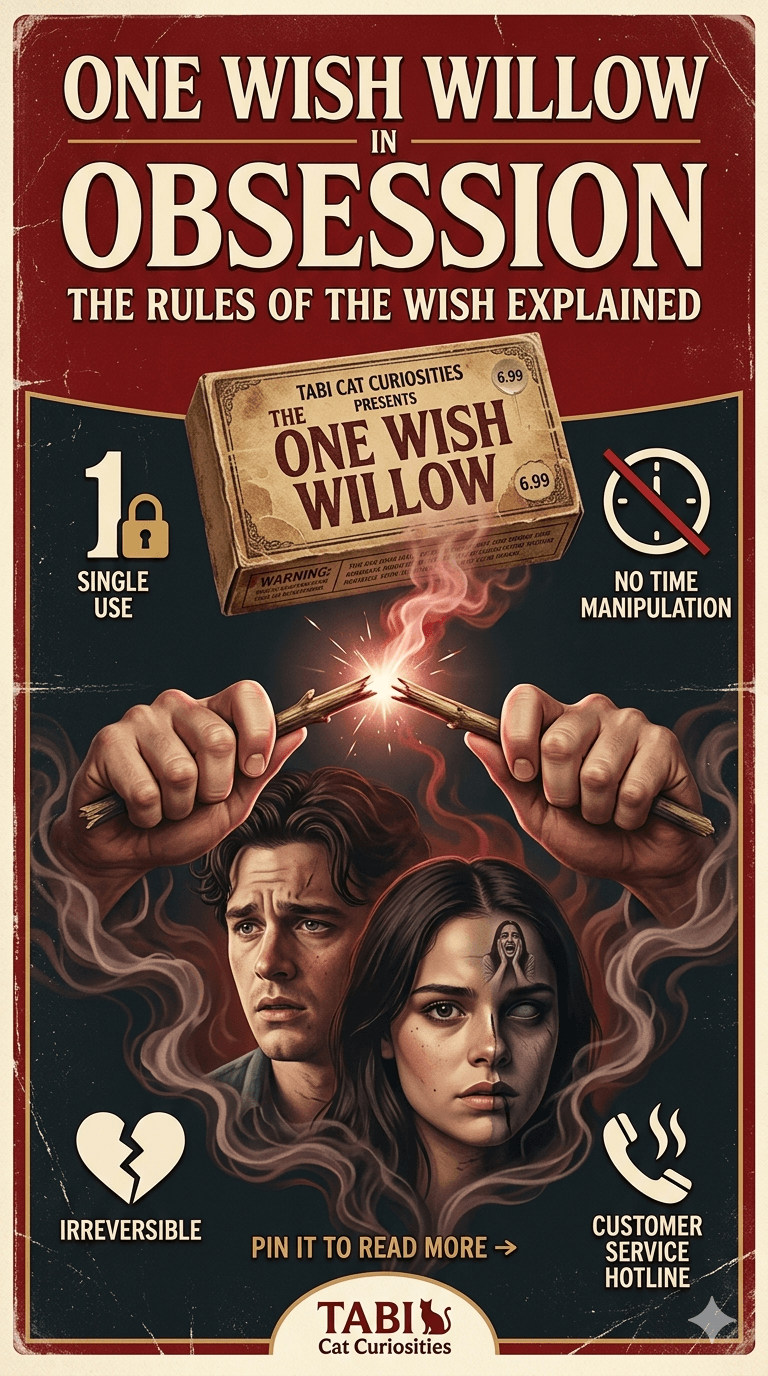
The One Wish Willow comes with explicit restrictions, printed in the language of a consumer product that expects returns and has already drafted its legal defense. Based on the box text, the film, and the official marketing website for the One Wish Willow: each Willow is single use only. One wish per person, per lifetime. Purchasing additional One Wish Willows will not change or affect existing wishes. Wishes are irreversible — once made, a wish cannot be undone, altered, or repeated. Users are advised to consider long-term effects before wishing. The product cannot grant wishes involving time manipulation, resurrection, immortality, or the creation of additional One Wish Willows. TABI Cat Curiosities accepts no responsibility for wish misinterpretations.Read that last clause again. “Wish misinterpretations.” As if what happened to Nikki Freeman is a customer service issue. As if the erasure of a woman’s autonomy, her psychological imprisonment inside her own body while a corrupted version of herself murders her friends, is a matter of unclear product labeling. The language is careful. The language is designed. And the language is the most honest thing in the entire film, because it tells you exactly what kind of entity is selling this product — one that knew what would happen, printed the warnings anyway, and structured the fine print so the fault would always belong to the user.
What the One Wish Willow Rules Don’t Tell You
The box covers the basics. The film reveals the rest, and every hidden rule of the One Wish Willow makes the object worse.The real Nikki still exists. She is trapped inside her own body, conscious, watching the corrupted version of herself operate her limbs and speak with her mouth. Curry Barker has clarified that
Obsession is, technically, the opposite of a traditional possession film — the One Wish Willow’s magic corrupted a part of Nikki’s psyche rather than replacing her entirely. Her true self remains inside, surfacing only when the corrupted version sleeps, and even then, only in whispers. Think of it as something closer to the Sunken Place from
Jordan Peele’s Get Out — conscious, watching, unable to act. In one of the film’s most devastating scenes, Nikki gains control of her own voice long enough to beg Bear to kill her. He refuses. He walks away. That refusal is the moment the film stops being a horror story about a wish and becomes a horror story about a man.The wish can only be broken by the wisher’s death. The customer service representative — voiced by Barker himself with the flat affect of someone earning minimum wage at a call center for the damned — confirms this when Bear calls the One Wish Willow hotline in desperation. The wish lasts as long as Bear lives. The line offers no reversals, no escalation path, no manager who cares more than the first person who picked up.A person who has already used a One Wish Willow cannot break another one. Bear discovers this when he steals three remaining Willows from the shop and tries to wish Nikki’s love away. The stick will not snap. It is physically impossible for him to use a second One Wish Willow — a supernatural safeguard that the box never mentions, because the box already told you: one wish per person, per lifetime. Bear understood the words. He didn’t understand the enforcement mechanism.Someone else can use a Willow on the wisher’s behalf, but they get their own wish — and their own consequences. Bear brings a One Wish Willow to his friend Ian and begs him to wish that Bear had never made his wish. Ian, not believing any of it, casually wishes for a billion dollars while laughing. The stick snaps. Money rains from the ceiling. Bear’s last chance evaporates in a shower of hundred-dollar bills and the specific stupidity of a man who was handed a loaded weapon and pointed it at himself because the whole thing seemed like a joke.
The One Wish Willow Phone Call Scene Explained
The most revealing scene in
Obsession is a phone call that lasts less than two minutes.After the wish spirals beyond anything Bear imagined, he calls the customer service number printed on the One Wish Willow box. A man answers. He sounds bored — the voice of someone who has fielded this identical call hundreds of times and will field it hundreds more and feels nothing about any of them. Barker recorded his own voice for the role on his phone while editing the film from his bedroom. The performance is perfect precisely because it refuses to be a performance — bureaucratic indifference applied to supernatural destruction, delivered with the energy of a minimum-wage worker who clocked in twenty minutes ago and is already thinking about lunch.The representative confirms the One Wish Willow’s terms: the wish cannot be reversed, and it expires when Bear dies. He speaks with the certainty of someone who didn’t design the system but understands it completely and has no interest in pret
ending the system is fair. Then he asks Bear if he’d like to speak with Nikki. Bear says yes. What he hears is the real Nikki — screaming. Endlessly, from whatever internal place the wish has confined her to while her body walks around kissing a man she never chose and murdering people she used to love. Bear hangs up.The call is never mentioned again. Everything the audience needs to understand about the One Wish Willow lives inside those ninety seconds — an object that works exactly as advertised, sold by an entity that understands exactly what it does, operated by a customer service infrastructure that treats the annihilation of a human being’s free will as a standard inquiry.
What the One Wish Willow Reveals About Bear
The One Wish Willow is a product. It has packaging, a price point, a customer service line, a manufacturer with a name and a logo. It sits on a shelf next to crystals and incense in a shop where people go to buy the feeling of spiritual engagement without the inconvenience of spiritual commitment. It is sold to people who want something badly enough to pay for it and casually enough to skip the warnings. The Willow is designed for impulse buyers. It is designed for people like Bear.And Bear’s wish — the specific words he chose — tells you everything the film needs you to know about him before the horror even starts. He didn’t wish that Nikki would be happy. He didn’t wish for the courage to tell her how he felt. He wished that she would love
him more than anyone in the world. The wish is possessive in its grammar. The object of the sentence is Bear. Nikki exists in that sentence as a delivery system — a mechanism through which Bear receives what he decided he deserved.The One Wish Willow doesn’t corrupt Bear’s wish. It fulfills it. Precisely, literally, with the consumer-product efficiency promised on the box. What Bear wanted was Nikki’s love without Nikki’s consent, and what he got was exactly that — love without personhood, devotion without agency, a woman who would do anything for him because the alternative was removed from her list of options. The Willow didn’t malfunction. Bear’s wish was the malfunction. The product performed as specified.TABI Cat Curiosities printed the warnings. The warnings were accurate. The buyer chose to proceed. And somewhere, a bored man answers phones for the company and processes the complaints of men who purchased the erasure of a woman’s autonomy for less than the price of a cocktail and are now upset about the return policy.
Obsession packages entitlement more clearly than any horror film I’ve encountered — literally packages it, in a box, on a shelf, with terms and conditions — and that is precisely why the
film works as well as it does. The One Wish Willow is a mirror sold as a toy. Bear looked into it and saw exactly what he was willing to do. The audience saw it too.
Frequently Asked Questions About the One Wish Willow
Is the One Wish Willow Based on a Real Object?
The One Wish Willow is fictional, created by writer-director Curry Barker for
Obsession (2026). Barker has said the concept is inspired by W. W. Jacobs’ 1902 short story
The Monkey’s Paw and a segment from
The Simpsons‘ “Treehouse of Horror II” in which the Simpson family uses a monkey’s paw with disastrous consequences. The willow-tree connection has roots in European folklore, where sitting under a specific type of willow and renouncing one’s faith was said to summon the Rokita, a devil figure who would grant one wish. Barker has not confirmed whether this folklore directly influenced the film.
Can You Actually Buy a One Wish Willow?
Yes. As part of the film’s marketing campaign, Focus Features launched a fully functional website where customers could purchase a replica One Wish Willow for $6.99. The replicas sold out. A working customer service phone number also played a recorded message from the One Wish Willow representative, voiced by Barker. The website includes the same warnings and fine print seen in the film.
What Are the Exact Rules of the One Wish Willow?
The rules, as established by the film and the product packaging: one wish per person, per lifetime. Wishes are irreversible. The wish takes effect immediately upon breaking the One Wish Willow stick. A person who has already used a Willow cannot break another. The wish expires only when the wisher dies. The Willow cannot grant wishes involving time manipulation, resurrection, immortality, or the creation of more Willows. The manufacturer accepts no responsibility for misinterpretation.
Can the One Wish Willow’s Wish Be Reversed?
Within the rules established in
Obsession, the wish cannot be directly reversed. Bear attempts three methods of reversal: calling the customer service hotline (denied), breaking a new One Wish Willow himself (physically impossible), and asking his friend Ian to use a Willow to undo the wish (Ian wastes his wish on money). Bear also asks Nikki to use her own wish to free herself, but the corrupted version of Nikki refuses. The only confirmed mechanism that ends the wish is the death of the person who made it.
What Happens to Nikki at the End of Obsession?
In the film’s theatrical ending, Bear overdoses on pills, which kills him and breaks the One Wish Willow’s curse. Nikki survives. The corrupted version disappears, and the real Nikki wakes up surrounded by the consequences — Ian dead, Sarah dead, Bear dead in her arms. She retains her memories of everything that happened while she was trapped. Director Curry Barker originally filmed a darker ending in which Nikki also dies, but changed course after Navarrette’s performance in the survival take convinced him and his team that leaving Nikki alive was more devastating. For a full breakdown, see our
Obsession (2026) review.
Who Is the Voice on the One Wish Willow Phone Call?
The customer service representative is voiced by Curry Barker himself. Barker recorded the dialogue on his personal phone while editing the film in his bedroom and has described the character’s energy as that of a disengaged minimum-wage worker. The identity of the representative within the narrative is never confirmed — some viewers interpret him as a supernatural entity connected to the One Wish Willow’s power, others as a mundane employee of a company that happens to sell magical objects. Barker has intentionally left the question unanswered.