A source told me once — during an investigation that had everything, documentation, dates, names, a paper trail that didn’t leave room for argument — that the truth doesn’t matter if nobody’s willing to print it. He said it quietly, without self-pity. He’d been carrying the sentence for a while by then. I’ve thought about it most weeks since.I thought about it again, on a loop, while I was researching this one.Jordan Peele’s
Get Out (2017) is a work of fiction built on a piece of documented American history, and the history is the part that should keep you up.
What Was the Tuskegee Syphilis Study?
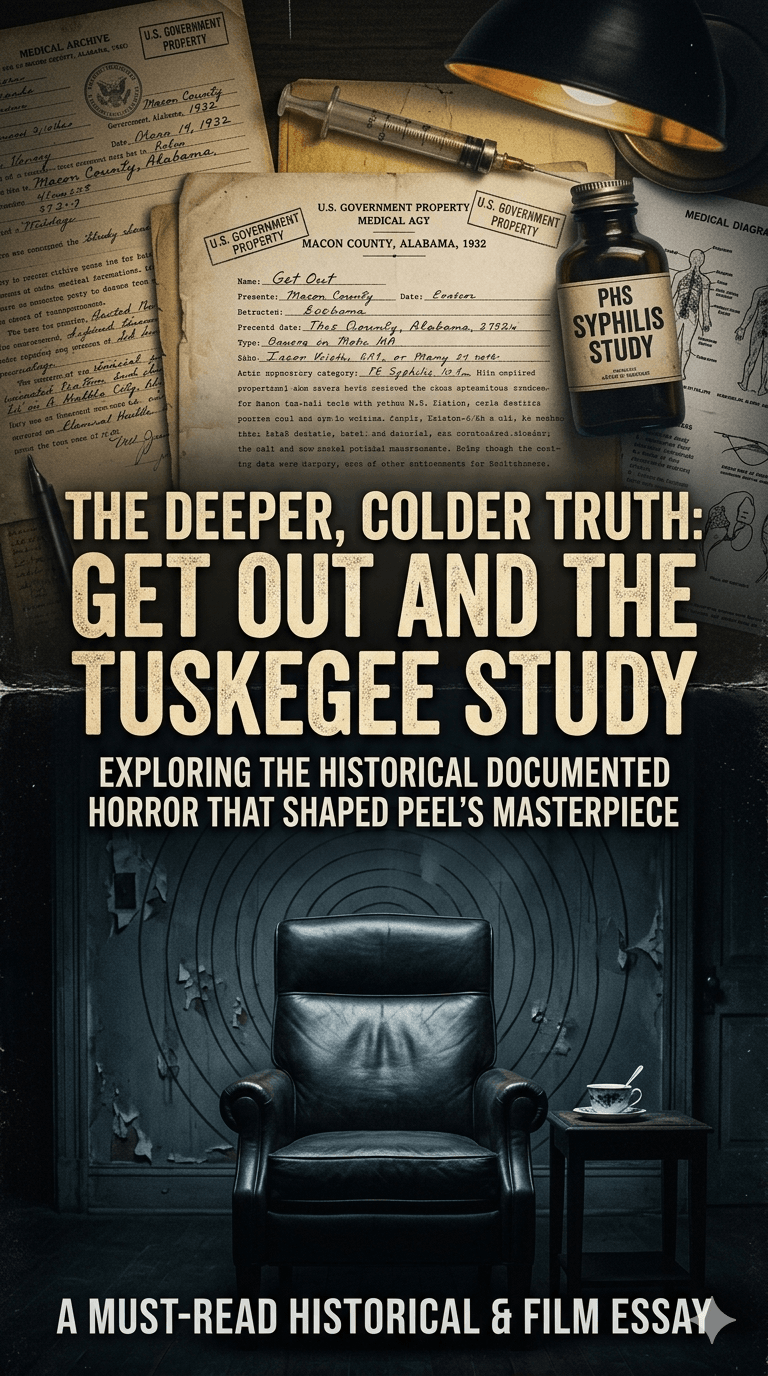
Between 1932 and 1972, the United States Public Health Service ran a study on 399 Black men in Macon County, Alabama. The men had syphilis. The USPHS knew. The USPHS told them they had “bad blood” — a local catch-all, deliberately vague, broad enough to mean anything — and offered them something they needed: free medical exams, free meals, burial insurance. The men took the deal. They had no reason not to. The federal government was offering help.That was the design.The study’s formal name was the Tuskegee Study of Untreated Syphilis in the Negro Male. The title states the intention with a precision that works as camouflage, because it lived in internal documents the participants would never read. The men went to their appointments and trusted the people examining them. They believed they were being cared for, and the examinations recorded the progression of a disease the PHS had decided to let run its course — year after year, no treatment, no penicillin, no intention of either.In 1945, penicillin became the accepted treatment for syphilis. In 1947, the USPHS opened Rapid Treatment Centers across the country built specifically to cure it. The men in Tuskegee were not among the cured. The same government that was assembling the infrastructure to eliminate syphilis in the general population kept observing the men it had already enrolled — documenting what untreated syphilis did to a body over decades, as if the existing literature were insufficient, as if what medicine required was a living, walking cohort of human beings followed until the data set was complete.The cure existed. The doctors knew it existed. They chose not to give it.At least 28 of the men died of syphilis as a direct consequence of going untreated. Others passed the disease to their wives, and some of those wives passed it to children who were born already carrying it — the infection crossing into a generation that was never enrolled in the study, never told about it, and never given the chance to refuse. The burial insurance the men had received as partial compensation went toward funerals the study itself had helped to cause. That particular detail sat in the case files for forty years.This is the spot where a certain kind of writer reaches for the word “unimaginable.” Imagination is exactly what the situation requires, because what happened was planned, budgeted, staffed, and supervised by an agency of the federal government. The men who designed it and the men who kept it running were institutional actors inside a system whose incentives all pointed one way. An institution made a decision about whose bodies could be used and then sustained that decision across multiple administrations, through a world war, through the discovery and mass adoption of penicillin, through the Civil Rights Movement, through the assassination of Martin Luther King Jr. An institution can sustain almost anything as long as nobody inside it is willing to say stop — and as long as the people who do say it can be sat back down efficiently enough.One person did say stop.Peter Buxtun joined the Public Health Service as a venereal disease investigator in the mid-1960s. He learned about the study and, in 1966, wrote to officials at the CDC laying out his ethical objections. He was summoned to Atlanta, where agency officials informed him — in the bureaucratic register institutions use when they mean be quiet — that his concerns had been reviewed and found to be without merit. He raised it again in 1968, in the middle of a country publicly reckoning with exactly what it meant to treat Black Americans as instruments, and was dismissed again. For six years the man had the truth, the documentation, a paper trail with no room in it for argument, and for six years the mechanism absorbed his concern and kept running. The CDC reviewed its own program. It found the program acceptable. That result will surprise no one who has watched an institution investigate itself.In 1972, Buxtun took the documents outside. He gave them to the Associated Press, and Jean Heller published the story on July 25, 1972. The outcry forced a federal review. The study ended that autumn. A class-action suit settled for $10 million in 1974, split among survivors and the families of the men who hadn’t survived. In 1997, President Clinton stood at the White House and delivered a formal apology.Twenty-five years after the study ended. Fifty-two years after the penicillin was withheld.A speech. They gave the families a speech.
Is Get Out Based on the Tuskegee Study?
Get Out gives the horror an origin, and it hands it to you casually, the way families hand down legends. On the garden tour, Dean Armitage mentions that his father, Roman, was a runner — good enough to make the qualifiers for the 1936 Olympics, where he lost to Jesse Owens in a preliminary heat. Roman never put it down. He came out of that defeat convinced that Black bodies were the superior machine, and he spent the rest of his life engineering a way to climb inside one. The procedure his family
refined over three generations — a white buyer’s consciousness transplanted into a Black host — grew out of a footrace a white man lost in Berlin in 1936.Hold that year against the other one. Roman lost to Owens in 1936. Four years before that, in 1932, the Public Health Service had already enrolled its first men in Alabama and told them they had bad blood. A fictional patriarch in upstate New York and a federal agency in the Deep South, working the same decade, arriving at versions of the same conviction: a Black body is a resource, and the person living inside it is a problem to be managed.The procedure, as the Armitages run it, comes in two stages. Missy Armitage, a psychiatrist, handles the front end: hypnosis, the induction of a state in which the subject’s consciousness is sealed off from his own body. Her husband Dean — a neurosurgeon, which is the film making institutional authority literal — performs the transfer on the table. What comes out the other side looks exactly like the person who went in. He walks around in his original body. His consciousness is locked in the basement the film calls the
Sunken Place, watching through his own eyes while someone else drives.The cruelty there is specific, and it’s the right cruelty. The procedure keeps its victims awake — paralyzed, sealed off, present, watching every decision get made by the thing wearing their face. That awareness is what makes the Sunken Place the most accurate image in the film. The Tuskegee men were awake too. They went to their appointments. They trusted the people examining them, because the people examining them carried the full administrative weight of the United States and presented, every time, as helpers. The Sunken Place is what a system looks like from the inside once it has made a decision about your body and has no intention of telling you what it is.Every program like this runs on a trusted face. The Armitages have Missy. The Tuskegee study had Eunice Rivers.Rivers was a Black nurse the PHS hired as the standing contact between the men and the doctors. She drove them to their appointments. She knew their wives and their children. For forty years she was the face the men saw most often — one that looked like theirs, spoke like theirs, carried the same continuity across four decades of exams. Historians have argued over her ever since: an accomplice to an atrocity, or a Black professional woman with no real authority inside a white federal institution in the Jim Crow South, doing the only job the system would give her. I’m not going to pretend to settle that, and I’ve learned to distrust anyone who settles it too fast in either direction.The function, though, I’m certain about. The institution needed the men to keep showing up for appointments they didn’t understand, and it needed them to open the door when the car pulled up. So it went looking for someone they’d open the door for. By every account Rivers was decent to the men, personally, throughout — and that decency was the exact thing the institution spent. That’s the colder fact, and the more useful one: a good person installed at the precise point where her goodness would do the system’s work for it.Missy Armitage sits across from Chris Washington and listens to him. She is warm, attentive, helpful. She asks the right questions. She stirs her teacup. The hypnosis is already underway. The warmth was the mechanism, and it worked the way warmth always works on a person in a vulnerable spot — it’s the one thing he can’t afford to examine while it’s happening.Horror that deals with institutional power usually treats the institution as a backdrop: a conspiracy the hero uncovers and eventually beats.
Get Out is more precise than that, because it understands that the institution doesn’t need a conspiracy. It needs people who find its operation acceptable. The Armitages’ party guests don’t pick up scalpels. They sit at tables and use bingo cards to bid on a man’s body over drinks, and then they drive home. The mechanism keeps running. Their willingness to sit there and bid is the mechanism.Tuskegee ran on the same principle. Directors of the PHS came and went. Administrations changed. The study was reviewed and re-approved, again and again, by people who looked at it and found it acceptable — ordinary institutional men inside a system whose incentives ran one direction, doing what the incentives rewarded. When an objection came in, the system reviewed the objection, found it without merit, and filed the finding. When you build the review process, you tend to win the review. Call it cynicism if you want; it’s really just a description of how accountability works inside any institution that controls its own oversight, which is to say most of them.The film has its version of the man who says stop, and it’s the bluntest move
Get Out makes. Rod Williams — TSA, Chris’s friend, the one watching from outside — works out that something is wrong and takes it to the police. He tells two detectives that a rich white family has hypnotized his friend and possibly cut into his skull. They receive it with the specific, bottomless patience institutions reserve for people they’ve already decided to ignore, and they laugh. So Rod stops asking the system for anything. He gets in his car and drives up there himself.Peele’s argument in that scene is unsubtle, and I think it’s right: some situations have no fix inside the system, because the system is the thing that needs fixing, and the only door that opens is the one marked outside. Buxtun found that same door. It took him six years to stop knocking on the official ones first — the letters, the Atlanta meeting, the formal complaints, the CDC clearing the CDC — and walk around the building to a reporter. The move that finally worked was Rod’s move. The difference is the part the film can’t show you. Rod gets there while his friend is still in the house. By the time Buxtun got there, the men in Alabama had been dying for forty years.
What the Tuskegee Study Left Behind
The legacy of Tuskegee is measurable, and it’s present tense. Research in recent years has found that Black Americans living in the counties nearest Macon County — where the memory of the study is geographically close — were slower to take the COVID-19 vaccine than white Americans in the same counties. The mistrust has a radius, and it compounds down the generations. It reaches the families of the men enrolled in 1932, their communities, and every later encounter those communities have with a medical institution that needs to be trusted before it can be of any use.The CDC keeps
a page about the study now. It’s written in the language of acknowledgment and reflection — lessons learned, institutional growth, the importance of research ethics in present-day practice.I’ll leave my opinion of that unprinted. Some of my better journalism never made it to print either.
Get Out’s ending and the Rescue That Never Came
Get Out gave Chris the ending the therapeutic function of film tends to require. Rod arrives, the system doesn’t save Chris, but his friend does, and he gets off the Armitage estate alive. Peele had shot the other version first — police lights, Chris arrested over the bodies on the lawn, Rod visiting him in prison, Chris saying he’s at peace because at least he stopped it. Test audiences couldn’t take it. He swapped in the TSA truck and let the dread out into something a person could breathe.The theatrical ending is the correct one, as horror. Watched from a certain angle, it’s also the fantasy.The Tuskegee men didn’t get the rescue. They got what the study’s architects had planned for them from the start: a record of a disease’s progression. Forty years of case files. Data. The material was written up. It entered the medical literature. It’s cited in papers. The Public Health Service ran its study, the study produced results, and the results got used.That’s the part of Tuskegee that refuses to land anywhere comfortable. The information was gathered. Somebody decided it was worth having. Somewhere inside the apparatus, the trade got made and found acceptable: the men’s lives against the data their lives would generate.My source was right that the truth doesn’t matter if nobody’s willing to print it. Buxtun found someone willing in 1972, and the study ended that autumn, and the families got their settlement in 1974 and their speech in 1997. The men who were handed burial insurance are still buried. The children born with congenital syphilis became whoever they became. The data is still in the literature.Watch
Get Out knowing what it’s drawing on — knowing the Armitages are a small, private, underfunded version of what the USPHS ran at federal scale for four decades — and the gap between the horror film and the documented history closes to something you feel instead of calculate. If you want the film on its own terms, what Peele built and whether it holds, that’s the
Get Out (2017) review. Peele called it a social thriller, a film about the horror of society. He undersold it.
Get Out plays like a horror writer’s extrapolation, the plausible pushed one step past real. The documented version was larger. The Armitages are the scale model. The USPHS built the full-size one, gave it a formal name, and ran it for forty years with a budget line.They called it a study. Everything you’d need to verify that is in the archive. The CDC keeps it there, filed between the headers about reflection and lessons learned, which is one way to store something you’d rather not store anywhere.
Get Out and Tuskegee: Frequently Asked Questions
Is Get Out based on a true story?
Get Out is fiction, but its core idea echoes documented American history. The Get Out and Tuskegee parallel is the clearest example: a federal study that catalogued Black men’s bodies while withholding care. Peele invented the Armitages, yet the logic of using Black bodies as material was already in the historical record.
What was the Tuskegee Syphilis Study?
From 1932 to 1972, the U.S. Public Health Service studied 399 Black men with syphilis in Macon County, Alabama, telling them they had “bad blood.” Researchers withheld treatment even after penicillin became a standard cure in the 1940s, observing the disease until at least 28 men died of it.
Did the Tuskegee Study really withhold a known cure?
Yes. Penicillin was the accepted treatment for syphilis by 1947, and the same Public Health Service built Rapid Treatment Centers to cure it nationwide. The men enrolled in Tuskegee were deliberately left untreated so the study could document the disease’s full progression. Whistleblower Peter Buxtun exposed it in 1972.