What “The Sunken Place” Stopped Meaning
The phrase has been used, in print, to describe Sammy Davis Jr.’s relationship with the Rat Pack, NFL players who didn’t kneel, athletes who did, and roughly every public figure accused of insufficient solidarity with whatever cause was trending that particular week. Jordan Peele coined it in Get Out (2017). Within a year he was using it himself to describe a president calling athletes vulgar names for protesting on a football field. By 2018 it had a Dictionary.com entry. By 2019 it was a category on Urban Dictionary with competing definitions, all variations on the same idea: a person who has become complicit in their own oppression, who can’t see it, or won’t.
That reading isn’t wrong. It’s just several sizes too big for the thing it’s describing. Somewhere between the Sundance premiere and the meme economy, a precise piece of horror dramaturgy got swapped for a political Rorschach blot, and almost nobody clocked the trade. The Sunken Place stopped being a thing that happens to one specific man in one specific chair and became a thing that could happen to anyone who disappointed you online. If the review that anchors this cluster was about the friend who saw the danger and got dismissed, this is about the device at the center of the trap.
The broadening was deliberate, and Peele engineered the elasticity on purpose — a metaphor built to survive contact with the culture. Fine. But elasticity has a price, and the price is precision. The version that circulates now, applicable to almost any situation involving power and silence, is not the version on screen. The version on screen is mechanically specific. It has a trigger, a method, and a result, and all three are worse than the slogan that replaced them. So before this gets flattened any further, here is what the scene does.
The Password: How Missy Actually Hypnotizes Chris
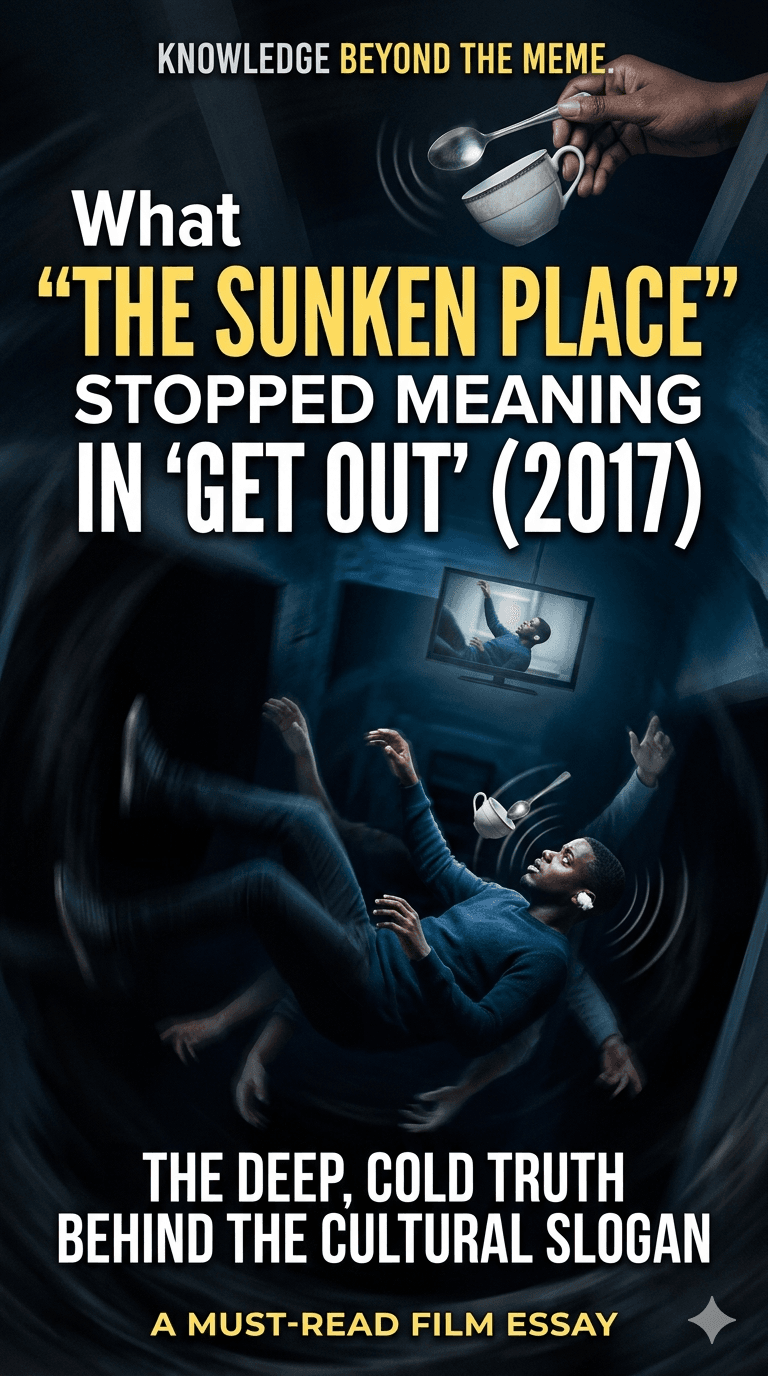
Missy Armitage doesn’t reach for a pendulum or a pocket watch. The screenplay makes a small joke out of that expectation and discards it — Chris asks whether she’s going to swing something in front of his face, and she lets him enjoy the irony before getting to work. What she uses is a teacup and a spoon, clinked at a specific rhythm, and a question she already knows the answer to: was he there when his mother died.
This is the detail that vanishes every time someone deploys “Sunken Place” as a synonym for generic compliance. The hypnosis isn’t a parlor trick performed on a stranger. It’s a key cut for one lock. And here is the part the broad reading misses entirely: Missy already had the key.
Chris handed it to her himself, an hour earlier, on the patio. Sitting with Dean and Missy over iced tea, asked about his parents, he told them — both of them, out loud — how his mother was hit by a car when he was eleven. Missy was right there. She heard him describe it, watched his face do the work, filed it away with the patience of a clinician who has done this before. No intermediary. No information leaked through Rose. Chris walked his own wound up to the people who would use it, because that is what you do when you’re trying to be liked by your girlfriend’s family.
So when she walks him into the trance, she doesn’t need to fish. She takes him straight back to the night of his mother’s death — to the eleven-year-old sitting on his bed, watching television, doing nothing, because some part of him understood that calling for help would make the thing real. She makes him relocate the sensation in his body, one channel at a time. Sound. Touch. Smell and taste together. Sight.
Each one is a separate instruction, delivered with the warmth a real therapist would use, which is exactly what makes it obscene — she is running the genuine grammar of trauma processing as a delivery system for its opposite. Aster builds entire films on grief weaponized as a horror engine; Peele does it in a single chair, with a spoon, in under five minutes of screen time.
Then the turn. “You think it was your fault.” Chris nods. She tells him to feel that fear again, paralyzed, like that day. Only once his body has located the exact frequency of an eleven-year-old’s guilt does she give the order. Sink. The Sunken Place isn’t a generic state of subjugation a villain can drop anyone into. It’s a wound the victim disclosed in good faith, weaponized against him with an access code he supplied himself. That’s a colder and uglier thing than the meme version, where the Sunken Place is just shorthand for any lopsided power dynamic. This one required hospitality first. The trap closes only because Chris was trying to be a good guest.
Rose Went There First, and Nobody Talks About It
There’s a line that slips past most viewers because it arrives wrapped in reassurance. When Chris tells Rose, the morning after, that her mother hypnotized him and left him with violent nightmares, Rose tells him it happened to her too — Missy put her under once as a kid, for stage fright, and she had the craziest dreams, but it worked. Rose offers this to calm him down. It does the opposite, if you’re paying attention.
Because it means the machinery in that house isn’t reserved for the people being harvested. Missy practiced on her own daughter. The same technique that will eventually drop Chris into the abyss was, at some earlier point, pointed at the family’s own child and waved off as a parenting tool — a cure for a kid’s nerves before a school play.
Whether Rose remembers her own session as a genuine fright or has rationalized it the way you rationalize anything a parent did to you “for your own good,” the detail tells you the Sunken Place isn’t an exotic weapon the Armitages built for outsiders. It’s a household instrument. It was always in the house, always in use, normalized at the dinner table years before Chris ever drove up. The horror of the place isn’t that it’s monstrous and foreign. It’s that it’s domestic, and that the people deploying it learned to deploy it on each other first.
This is the kind of seed Peele plants and never waters in dialogue, trusting the structure to carry it. Rose, the most monstrous figure in the film by the end, was herself once laid out in that chair with a spoon clinking beside her. It doesn’t make her sympathetic. It makes her a product — the next generation of a family that treats consciousness as something you can switch off in someone you claim to love, and feel fine about in the morning.
The Passenger: Consciousness Without Control
Jim Hudson explains the mechanics later, from the hospital bed, with the unbothered cadence of a man who has done this enough times that the horror has gone procedural. Chris will still be in there, he says — still able to see and hear, but reduced to an audience. A passenger in a body he no longer drives. Chris finishes the sentence for him: the Sunken Place. Jim confirms it, pleased the terminology has caught on even among the people it’s done to.
This is the structural cruelty the broad cultural reading consistently underweights. The Sunken Place doesn’t delete Chris. Deletion would almost be mercy. It converts him into a spectator of his own deletion — fully conscious of what’s being taken, physically incapable of objecting to the theft.
Watching yourself disappear in real time, with no ability to intervene, is the most exact dramatization of helplessness a screenplay has ever bothered to stage literally rather than merely describe. The Armitages’ deeper origin in the Order of the Coagula explains why they built the machine; this scene is what the machine feels like from inside. And it lands harder than the slogan because it’s specific. A hashtag generalizes. This chair does not.
You don’t have to take Jim’s word for what that condition feels like, either, because the film already showed you a man living inside it with the lights on. Andre Hayworth — the jogger snatched in the opening, reappearing at the party as “Logan,” ascot and golf hat and a voice scrubbed of everything that used to be his — describes his own existence, when the camera flash briefly jolts the real Andre to the surface, as being trapped in a dark room watching his life through a window. That’s not metaphor he’s reaching for. That’s a status report from inside the Sunken Place, delivered by someone who’s been there long enough that the warning comes out as small talk before the panic overtakes it. Andre is what Chris is being prepared to become: present at his own party, performing his own pleasantries, while the actual man is pinned behind glass screaming at a room that only sees the host. The film gives you the destination before it shows you the descent.
Cinematographer Toby Oliver built the visual grammar around an explicit reference: the netherworld sequence in Jonathan Glazer’s Under the Skin, which gave him a starting point for a consciousness adrift in its own collapse. The execution is defiantly low-tech for a sequence this iconic. Daniel Kaluuya hangs on a limited-range wire rig. Fans blow his clothes to suggest drift. The fall is shot at two hundred frames per second — the ceiling of the Alexa Mini — using a method borrowed from dry-for-wet underwater photography, where you shoot a dry stage to look submerged. A man on a wire in a dark room, filmed at a frame rate meant for liquid. The trick is simple, and that’s precisely why it reads as falling.
Above him hangs a screen. Peele refuses to let it stay metaphorical — it’s an actual suspended rectangle of light, showing Chris his own eyes’ perspective from the outside, the way a television shows you footage of an event you aren’t present for. Missy’s face appears on it, looking down at him through his own eyes, then reaches into the frame and shuts them. The film is telling you, with total visual literalism, that consciousness without agency is indistinguishable from watching television about yourself. Chris is a photographer. His entire skill is capturing what he sees through a lens, and the device turns that eye against him with something close to elegance. The thing that used to belong to him now belongs to whoever controls the frame.
Composer Michael Abels works the same idea from underneath. He wanted voices harmonizing into something unnatural — a disembodied spiritual, the absence of hope given a register — and landed on a Swahili choir meant to evoke ancestors trying to warn Chris from outside the frame of his own story. Sit with what that implies inside the film’s logic: a chorus of the dead is attempting to reach him, and he can’t hear it, because the apparatus built to silence him is louder than any warning history can send. The ancestors are screaming through the score. The Sunken Place doesn’t carry their signal. That’s the whole horror of the place in one production decision.
The Garden Party Was the First Rehearsal
The party earlier in the film runs a quieter, deniable draft of the same mechanism, and it matters because it shows the trick before the film makes it literal. Chris is examined, complimented, interrogated about “the African American experience” by a semicircle of strangers who’d clearly been discussing him before he arrived. He’s photographed without consent for an auction he doesn’t know is underway. Present, audible, technically free to walk away — and functionally with no more control over how he’s read in that backyard than he’ll later have over his own hands. Oliver shot the sequence to keep the menace just outside every frame, party guests leering in close-up the instant Chris looks elsewhere. It’s the Sunken Place with the volume turned down. The social machinery does the same job, slower and with better manners, and the film trusts you to recognize the louder version when it finally arrives. The hypnosis chair isn’t a new idea at that point. It’s the same idea, run at maximum.
What the Flattened Version Costs You
Kaluuya described the role, in interviews around release, as the feeling of being a passenger in your own life. Paralyzed. Wanting to say something and having it surface somewhere else, later, as rage, because you couldn’t put it where it belonged. That’s a more exact account of the mechanism than most of what’s been written about the Sunken Place since — including some of what Peele himself has said in the years after the film made him a brand and turned the phrase into a hammer he started swinging at targets well outside the original blueprint.
That should bother a serious critic, and I’m not going to be polite about it. The man who built the most precise metaphor in modern horror is also among the people who sanded it down to its most exportable, least specific form, and a craftsman knows the difference between a scene and a slogan even when it’s his own. Letting a metaphor wander into the discourse is one thing. Personally swapping the diagnosis for the bumper sticker is another, and the bumper-sticker version is the one that won — because it’s easier to carry. What got left behind in the trade is everything that made the scene work: the teacup, the frame rate, the choir that couldn’t get through, the specific theft that needs intimacy before it can begin.
One detail earns its own breath here, because it’s where the film lets its metaphor fight back without narrating the symbolism. Chris doesn’t out-think the hypnosis. He tears cotton from the upholstery of the chair he’s strapped to and packs it into his ears so the teacup can’t reach him. The material that built an economy on the backs of people who looked like him becomes the one thing standing between him and a second theft. Peele never underlines it. The object does the work, the way craft is supposed to, while the internet keeps arguing about what the Sunken Place “represents” and missing that the represented thing was never abstract. It had a teacup. It had a wire rig. It had a chorus of ancestors and a barrier built to keep them out.
Chris gets out, the way the title always promised. But the version of him who walks away carries something no hashtag holds: the bodily knowledge of what it costs to be made into an audience of yourself. The meme can’t fit that. It was never meant to. Read at the level of the chair instead of the slogan, the Sunken Place is a single man who learned, in his own nervous system, that the cruelest prison is the one that lets you watch.
What is the Sunken Place in Get Out?
The Sunken Place is the trance-like void Missy Armitage’s hypnosis sends her victims into. The conscious mind is pushed into a dark abyss where it can still see and hear through the body’s eyes but can no longer control it — reduced to a passenger watching life through a distant screen while another consciousness takes over.
How does Missy send Chris to the Sunken Place?
Missy uses a teacup and spoon, clinking them at a fixed rhythm while guiding Chris back to the night his mother died. She locates his deepest guilt — that he did nothing while his mother lay dying — and once he relives that paralysis, she orders him to “sink,” dropping him into the Sunken Place.
How does Chris escape the Sunken Place?
Chris pulls cotton stuffing from the arm of the chair he’s strapped to and packs it into his ears, blocking the sound of Missy’s teacup. Without the audio trigger, the hypnosis can’t take hold, so he stays conscious and in control of his body when Rose comes to prepare him for surgery.
Why is the Sunken Place such a powerful metaphor?
Because it dramatizes helplessness literally rather than describing it. The victim isn’t erased — he’s forced to watch his own erasure, conscious and unable to object. That image of seeing everything while controlling nothing gave audiences an exact picture of powerlessness, which is why the phrase spread far beyond the film itself.
Who created the look of the Sunken Place scene?
Cinematographer Toby Oliver shot it, drawing on the netherworld sequence from Jonathan Glazer’s Under the Skin. Daniel Kaluuya hung on a wire rig with fans blowing his clothes, filmed at 200 frames per second using a dry-for-wet underwater technique, while composer Michael Abels scored it with an unsettling Swahili choir.