
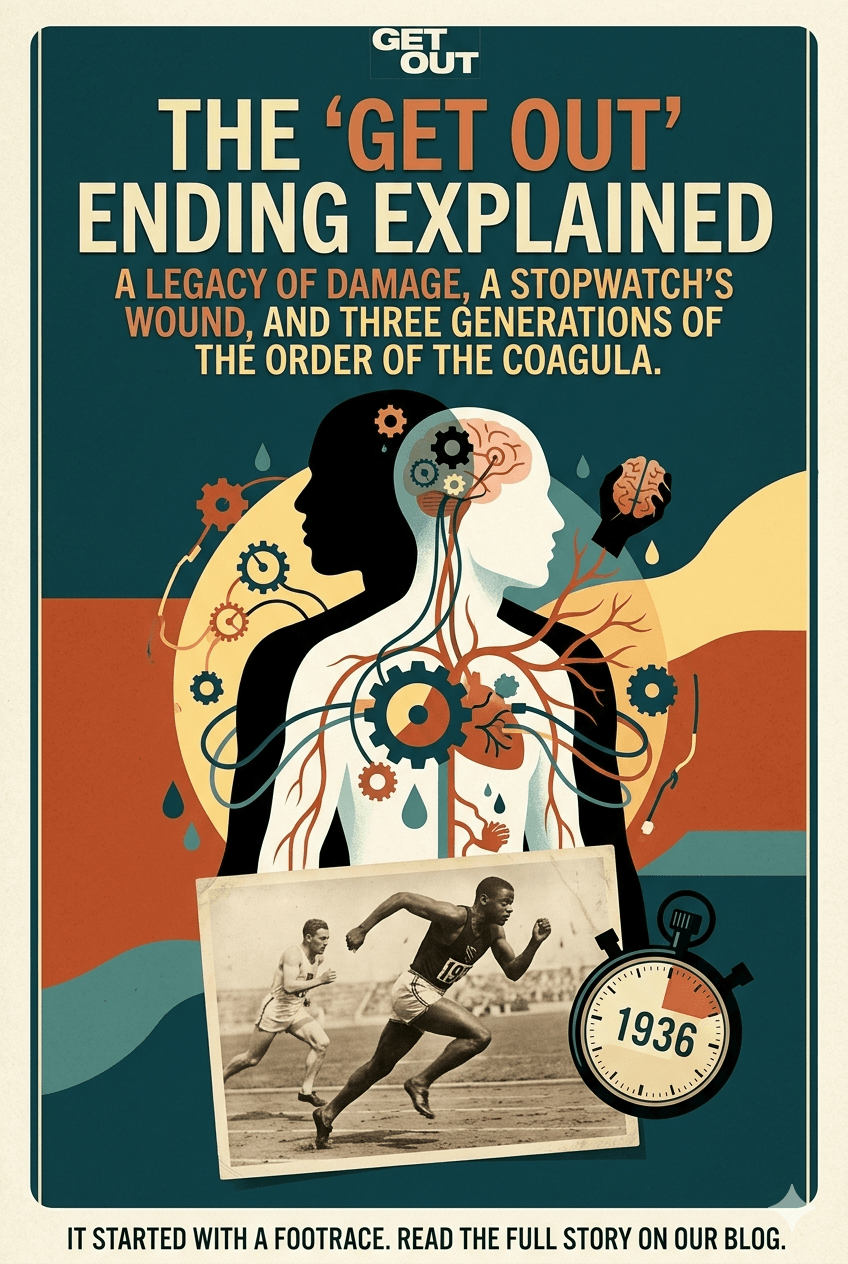
The Get Out ending explained is ultimately a story about a footrace — and three generations of damage built on losing one. Somewhere in the middle of Jordan Peele’s Get Out (2017), Dean Armitage walks Chris down a hallway lined with family photographs and tells him, almost in passing, about his father. Roman Armitage was a sprinter. A good one. Good enough to make it to the qualifying heat for the 1936 Olympics, where he lost to a younger, faster runner named Jesse Owens — a defeat that happened months before Owens ever set foot in Berlin, before the gold medals, before the photograph of Hitler watching a Black American humiliate the regime’s entire racial theology on its own track.
Dean tells the story almost fondly, the way you’d describe a grandfather’s war wound. Tough break, Chris says. Dean smiles and says his father almost got over it.
He never did. And the entire machine that follows — the hypnosis, the auctions, the partial brain transplants, three generations of a family that has practiced racial warmth so long it no longer feels like practice — all of it traces back to that one early morning on a track somewhere in America, where an unremarkable man came in second to a man he believed should have, by every law he privately held sacred, come in last.
The Origin of the Order of the Coagula in Get Out
I keep returning to how small that origin is. Horror usually wants its founding wounds to carry some scale — an ancient pact, a buried massacre, a curse with teeth. Roman Armitage’s founding wound is a stopwatch. He didn’t lose a war. He lost a heat. He wasn’t humiliated in front of the world; he was humiliated in front of a handful of other hopefuls on a domestic track months before the actual Games, a defeat history wouldn’t have bothered recording if Roman hadn’t spent the rest of his life and the lives of his descendants making sure it never stopped happening. There’s something almost unbearably petty about it, and I think that pettiness is the point.
The Armitages have dressed their family business in the language of destiny and immortality, but Dean tells the real story without seeming to notice he’s done it. It started with a stopwatch.
What Roman did with that defeat is the part that should unsettle you more than anything that happens in the basement. He spent years on it, quietly, the way certain men turn a private wound into a discipline. What came out the other side was a theology — a festering arithmetic that treated Owens’s speed as evidence, proof that the body holding it carried something his own never would.
And rather than let that evidence humble him, Roman decided the correct response was acquisition. If the body was the thing he lacked, the body was the thing he would eventually own. Generations later, his son would find the science to make that literal — a partial brain transplant, the host’s nervous system kept intact, the new mind layered over it like a hand into a glove — but the want came first, fully formed, from one man who couldn’t let a 1936 qualifying heat stay in 1936.
The “Behold the Coagula” Video Explained
There’s a video they show Chris before the procedure, an old recording of Roman explaining the Coagula doctrine directly to camera, and I think about that video more than almost anything else in the film. It means Roman scripted his own resentment into a permanent artifact, something durable enough to outlive the body that first felt it, designed to be replayed for every captive who comes after.
It is, structurally, an orientation video. A company history reel. The kind of thing new hires watch on their first day, except the institution is a kidnapping ring and the founder’s myth is white genetic anxiety dressed up as inheritance and destiny. Whoever recorded that footage understood that a private grudge doesn’t survive a single lifetime unless someone takes the trouble to institutionalize it — to turn a feeling into a procedure, a procedure into a doctrine, a doctrine into something you can replay for a stranger strapped to a chair, and somewhere along the way, start calling that replay an introduction.
I find myself wondering how many times that video has played. Whether anyone in the family has watched it so often they no longer hear it. Whether Dean, prepping for another surgery, ever lets it run in the next room the way you’d leave a television on for company.
Jim Hudson and the Auction Scene in Get Out Explained
Right after Roman’s recorded sermon plays out, the screen cuts to Jim Hudson live, on a video call from a hospital bed, and the contrast is worth sitting with. Roman speaks from the past, already gone, already a relic of his own grievance. Jim speaks from the present, very much alive, and entirely indifferent to it. He has no stake in Jesse Owens or in 1936. He’s a blind art dealer who built his career on appreciating other people’s vision, and what he wants from Chris is one specific thing: the eye that took the photographs he’s been admiring without ever fully being able to see them himself.
This matters because it tells you something about what a grudge does once it survives long enough to become an institution: it stops requiring the grudge. The Order began as one man’s specific, personal resentment of one specific man’s specific victory. By the time it reaches Jim Hudson, it’s just a marketplace.
Someone built a procedure to settle a private score, and three generations later, total strangers are placing bids on a lawn for entirely unrelated reasons of their own — eyesight, a swing they used to have, whatever drove the Greenes or the Deets or the Waldens to write down whatever number eventually got them outbid by Jim Hudson’s chauffeur. Roman wanted Jesse Owens’s legs. Jim Hudson wants Chris’s eye for photography.
The machinery doesn’t care which want it’s serving, as long as someone keeps paying to use it.
That’s what makes the Get Out ending explained resonate beyond genre: the auction scene works as more than plot mechanics. The same collapse — from personal wound to institutional appetite — surfaces in Hereditary’s ending, where a family’s private mythology becomes a machine that destroys everyone inside it. It’s an indictment of how institutions actually metastasize — through infrastructure flexible enough that anyone with money and an unrelated want can plug into it, regardless of whether they ever cared about Jesse Owens at all.
How Each Armitage Inherits Roman’s Obsession Differently
Once you see the engine, the rest of the family clicks into a different kind of focus, and what strikes me isn’t how monstrous each Armitage is on their own. It’s how differently the same inheritance gets worn by each generation, the way a family trait shows up as a different feature on every face.
Dean turned his father’s appetite into competence, methodically, the way you’d finish a renovation someone else began decades ago and never had the tools to complete. A neurosurgeon’s bedside manner launders the whole operation into something that resembles medicine — consent forms nobody signed honestly, a calm professional cadence he probably uses on his real patients too. He is, in a real sense, his father’s finished project.
Missy is the one who unsettles me most, because what she does isn’t inherited the way Dean’s competence is. She married into the family carrying her own separate skill, and what she did with it was figure out how to make abduction feel like therapy. What she actually uses to get Chris into the chair is a fear that was already there waiting for her — his mother, killed by a hit-and-run when he was eleven, the night he sat frozen in front of the television instead of calling anyone, the guilt he’s carried since for not looking for her in time.
That wound is entirely Chris’s own. The Armitages didn’t manufacture it. Missy simply found the door someone else had already built into him and walked through it.
Roman once turned his own grief into appetite and handed it down as inheritance — except Missy doesn’t even need a family history to do the damage. She just needs an afternoon and a teacup. The mechanics of that violation — a mind taken over by someone else’s agenda without consent — run through Rosemary’s Baby’s ending as well, just dressed in different furniture.
And then there’s Jeremy, who hasn’t been handed any of the science or the polish, only the rawest cut of the original feeling — drunk at a dinner table, grabbing Chris by the shoulders, marveling out loud about what a beast Chris’s body could become if he ever really trained it. Jeremy doesn’t know he’s quoting his grandfather. He thinks he’s making conversation.
That’s the detail that sits with me longest, longer than the surgery, longer than the auction. Jeremy has no idea where his own fascination comes from. He’s twenty-nine, drunk, showing off a half-remembered judo hold, genuinely under the impression that admiring Chris’s frame is just something he, personally, happens to think. He has no memory of 1936 because he wasn’t there for it and was never told the story as anything but a charming family anecdote about a tough break his great-grandfather almost got over.
The doctrine has been running so long it no longer needs to announce itself as doctrine. It just shows up at the dinner table as enthusiasm, dressed as a compliment, indistinguishable — even to the person feeling it — from genuine admiration.
I don’t know a cleaner definition of how prejudice actually survives across a family than that: appetite that has long since forgotten where it came from, mistaken by the person carrying it for nothing more than taste.
The Armitage House as a Symbol of Inherited Myth
The house itself seems to know what it’s hiding, even if the family living in it has stopped noticing. Production designer Rusty Smith built the Armitage estate as a Colonial Revival manor — the kind of architecture that performs an inherited American past whether or not anyone living there has actually earned the inheritance.
A stuffed lion still stands in Rose’s childhood bedroom like a forgotten heraldic mascot. The hallway runs thick with period portraits of ancestors nobody can specifically name, taxidermy, paintings of medieval battles on walls that have nothing literally to do with medieval anything. It’s the visual equivalent of Dean’s toast about knights of old at the party — a family borrowing the aesthetics of nobility and conquest to dignify something that is, underneath the wallpaper, simple theft.
Jeremy’s opening abduction of Andre even comes with a tubular medieval knight’s helmet, a detail Peele has confirmed traces to a much deeper backstory he wrote for the group: centuries of self-mythology, a belief in their own destiny for immortality, language borrowed straight from the Holy Grail. Sit with the gap for a second. They’ve built themselves a lineage stretching back hundreds of years. The truth, the only truth the film actually shows us, is one man, one morning, one race he lost by a margin nobody else would have remembered.
Why Walter Shoots Himself at the End of Get Out
The flash that eventually breaks Walter open isn’t new information by the time it happens. The film shows you the mechanism early, at the party, when Chris’s camera catches Andre off guard and something in him surfaces for just long enough to scream the film’s title before the family wrestles him back inside. At the time, it plays like one disturbing outburst among many — Dean calls it a seizure, and the rest of the guests accept the lie because accepting lies is the entire function of that party.
It’s only in hindsight, once Chris is the one strapped to a chair, that the moment reveals what it always was: a blueprint, hiding in plain sight as a scare. Andre’s eruption proves the door exists. Walter is what happens when someone finally has both the reason and the will to walk all the way through it.
Walter is where all of this arrives, and Walter is where I think the film is at its most quietly devastating, because Walter is Roman now — has been Roman for who knows how long, ever since the old man’s consciousness moved into a younger, faster body the same way Roman always wanted to. There’s a cruelty in that detail I don’t think the film needs to underline, so it doesn’t. Roman spent his whole life wanting Owens’s body, and Roman finally gets a body like it, except it isn’t a gift, it’s a theft, and the man whose body it actually is doesn’t disappear. He’s still in there.
Limited consciousness, Jim Hudson calls it later, an audience watching its own life from somewhere behind the eyes. Whatever you make of Walter’s nightly laps around the estate, the ones Missy waves off as harmless compulsion, it’s hard not to read them as something closer to training than habit — Roman, eight decades on, still running the same race, this time in a body fast enough to finally win it. He just had to take someone else’s to do it.
When Chris finally uses that same flash on Walter in the final chase, for a few seconds the real Walter surfaces, fully himself, fully aware, in front of the man who has been hunting him on Roman’s behalf for who knows how many years.
And Walter, given those few seconds — the only freedom the film ever grants him, the only moment in ninety minutes where the man underneath Roman gets to act instead of be acted through — takes Rose’s rifle, shoots her, and then turns the gun on himself before the flash wears off and Roman can reclaim what’s his.
I keep asking myself what that choice actually is. Call it an act of war, the only one the man has left — the single decisive strike against a family that’s worn him like a coat for who knows how many years. Call it a kind of mercy too, though mercy aimed entirely at himself, since the only thing the moment guarantees him is that Roman goes down with him instead of outliving him in someone else’s skin. Whatever the right word is, it functions as the last available form of ownership: his body was the one thing the Armitages could take, so ending it becomes the one thing they can’t take back.
I don’t know that the film wants us to feel triumphant about that, exactly, and I’m not sure I do either. Walter doesn’t get his life back. He gets the end of someone else’s. The doctrine that started with a man who couldn’t accept losing a footrace finishes with a man finally choosing, on his own terms, to lose everything rather than keep winning for somebody else.
There’s a version of this ending that reads as justice, and there’s a version that reads as a man so worn down by the cost of survival that erasure starts to look like the only dignity left on the table. I’m not sure those two readings cancel each other out. I think they’re both just true, sitting next to each other, the way the worst endings usually are.
What I keep coming back to in the Get Out ending explained, more than the procedure, more than the auction, more than the parts of this film people quote at parties, is how little it actually took to start it. Not centuries. Not a curse.
A man in his twenties who lost a race he was supposed to win, who decided the correct response to that loss was envy calcified into appetite, appetite passed down as doctrine, doctrine eventually given the dignity of medical science by a son who never once, as far as the film shows us, stopped to ask whether his father’s grief over a stopwatch was worth what it cost everyone standing downstream of it. Roman never got over the 1936 qualifying heat. He just made sure, for three generations, that almost nobody else got the chance to either.
Get Out Ending Explained: Frequently Asked Questions
What is the Order of the Coagula in Get Out?
The Order of the Coagula is the secret society at the center of Get Out ending explained, led by the Armitage family. Members undergo a partial brain transplant, implanting their consciousness into the bodies of healthy, athletic Black people while the original mind remains trapped in a passive “Sunken Place.”
Why did Roman Armitage create the Order of the Coagula?
Roman Armitage, the family’s founder, lost a 1936 Olympic qualifying heat to Jesse Owens. Unable to accept the defeat, he developed an obsession with Black physicality, eventually founding the Order to literally acquire the bodies he believed had bested his own.
What does Jim Hudson want from Chris in Get Out?
In the Get Out ending explained, Jim Hudson — a blind art dealer — wants Chris’s eyesight specifically. He wins Chris at the family’s auction not out of racial resentment but admiration for his photography, showing how the Order’s market has outgrown founder Roman Armitage’s original motive.
Why does Walter shoot himself at the end of Get Out?
A camera flash from Chris’s phone briefly frees the real Walter from Roman Armitage’s control. Given only seconds before Roman would reclaim his body, Walter shoots Rose and then turns the gun on himself, ensuring Roman cannot survive in his body any longer.
Is Walter actually Rose’s grandfather Roman Armitage?
Yes. Walter, the Armitage groundskeeper, hosts the transplanted consciousness of Roman Armitage, the family patriarch and founder of the Order of the Coagula. Similarly, the housekeeper Georgina hosts Roman’s wife, Marianne Armitage.