

There’s a scene in the middle of Obsession where Bear calls customer support. He has trapped his best friend inside her own body, the situation has gone visibly, catastrophically wrong, and his response is to phone the company. A voice on the other end — Curry Barker himself, in an uncredited cameo that doubles as the film’s driest joke — informs him the wish expires only when he or Nikki dies. Then the voice asks if he’d like to speak with the real Nikki. What comes through the phone is screaming.
Bear hangs up. And stays with her.
Sit with the premise of that call for a moment, because it tells you everything about who Bear in Obsession (2026) actually is. He doesn’t call to free her. According to the film’s own logic, he calls to renegotiate — to adjust the terms of a wish that has become inconvenient, the way you’d dispute a charge or ask about a warranty. The most morally catastrophic decision of his life, and he treats it as a customer service issue. The camera holds on him at the exact moment he learns the full cost of what he’s done, watches him absorb it, and watches him decide the cost is acceptable.
I called Bear recognizable in my review of Obsession, and I stand by it. This piece is about going deeper into the character — because the discourse around Bear in Obsession is getting him slightly wrong, and the ways it’s wrong turn out to be the most interesting thing about the film.
Who Bear in Obsession (2026) Is Before the Wish
The film sketches Bear’s life fast, and every stroke earns its place. Mid-twenties. Music store job he treats as a holding pattern. A cat that just died from getting into pills, which he cleans up alone, wearing rubber gloves and a dust mask, in a house that smells like the life he’s been postponing. He rehearses love confessions in his car, workshopping the wording with Ian on speakerphone like a man preparing a deposition. He has spent years orbiting Nikki Freeman, cataloging their shared history — the marching band years, the small kindnesses, the inside jokes — like evidence in a case he’s building.
That cataloging habit deserves more attention than it gets. Watch how Bear talks about Nikki in the early scenes: everything is timeline, precedent, accumulated credit. Six years of friendship, deployed as an argument. The film understands something uncomfortable about a certain kind of devotion — that it can function as bookkeeping. Bear has been making deposits into an account Nikki never opened, and the rage under his sadness, the thing Johnston lets flicker through in the parked car, is the rage of a man who believes he’s owed a withdrawal.
Michael Johnston plays him soft, and the softness is strategic. Bear reads as harmless, so the audience extends him the credit Nikki does. Two decades of romantic comedies trained us to see the patient, yearning best friend as the hero of a story he’s waiting to begin — the guy whose persistence will be rewarded in the third act, because persistence is what the genre calls love. Barker takes that training and turns it into the film’s first trap. The opening act plays Bear’s longing nearly straight. You’re allowed to feel for him. You’re supposed to. When he fumbles the conversation in the car outside her house, the scene is staged as comedy, and the theater I saw it in laughed warmly, on his side. The film needs you slightly complicit before it shows you what the longing contains.
What the Wish Actually Says
In the review I argued that the One Wish Willow works as a moral accelerator — it fast-forwards damage that already existed. Here I want to push past that reading, into the wording itself, because the wish is the closest thing the film has to a confession.
Bear wishes Nikki would love him more than anyone in the world. Read the sentence again, slowly. It contains a ranking. It measures her love against every other bond she has — her friends, her family, her work, herself — and demands first place. There’s nothing in it about her happiness. Nothing about whether they’d be good together, nothing about what her life becomes once the sentence takes effect. The wish is a possession order drafted in the language of romance, and the film simply executes it as written.
The film is scrupulously fair about warnings, too. The shop clerk tells him, deadpan, that the people who open these boxes end up complaining, or worse. Bear laughs at her. He treats the warning as part of the bit, the same way he treats most of what other people tell him — as texture in a story that’s fundamentally about him. The supernatural element of Obsession does exactly what it’s told, which means every horror that follows traces back to a sentence Bear composed himself, half-drunk on rejection, in a parked car outside her house.
That’s the detail the accelerator reading leaves out, and it matters for understanding Bear in Obsession as a character: the wish required authorship. The Willow didn’t interpret his loneliness or extract some buried desire he’d have been ashamed to speak. He chose the words. He said them out loud. The film’s cruelest structural joke is that Bear spends the rest of the runtime horrified by a sentence he could have phrased a hundred gentler ways.
Every Exit Bear Refuses
What separates Bear from the standard horror protagonist is how many doors the film opens for him. Horror loves a character who can’t escape. Obsession built one who won’t, and then made us count the exits with him.
The morning after the wish, Nikki’s behavior is already wrong — wrong enough that Bear is visibly unsettled. He could tell someone. He manages the situation instead, smoothing her strangeness over in front of their coworkers, already halfway into the role he’ll occupy for the rest of the film: handler.
Then the lie about her father collapses. Ian does the checking Bear never bothered to do and calls with the news: the dying-father story was fabricated. This is the moment a journalist appreciates — Bear now has documented evidence that the woman professing love to him is running on something other than truth. He sits with it for a beat. And he decides it changes nothing, because the arrangement is working for him. The lie gets filed away with everything else.
The escalations that follow each carry their own off-ramp, and Bear declines every one. The morning he finds what Nikki made him for breakfast — the film’s most notorious image, involving what remained of his cat — would send any sane person out the door and probably to a church. Bear stays. The customer support call, which he places to amend his wish rather than end it, hands him the exit condition explicitly and lets him hear exactly what his wish feels like from the inside of her skull. He stays. The party at Ian’s house, where Nikki’s performance of devotion curdles into public self-destruction in front of every witness he knows, ends any possibility of pretending this is private, manageable, his to contain. He stays.
And then there’s the night scene. The real Nikki surfaces while the obsessed version sleeps, and in a whisper, she begs him to end it. She tells him, in essence, that she has been present for all of it — a passenger behind her own eyes, conscious for every kiss and every humiliation. Bear’s response is the cruelest beat in the film, and Barker shoots it flat, no score, the room silent. Bear takes offense. He has just been told, by the woman he claims to love, that existence with him is torture, and what he registers is the insult. He walks out of the room. The film’s entire moral argument lives in that exit: from this point on, Bear has perfect information, and the remaining hour is a man choosing, scene after scene, with full knowledge of the cost.
Even after Sarah, when the cost stops being abstract and becomes a body, Bear’s instinct is concealment. He lies to protect the arrangement. By then the lying is fluent — he’s had practice.
Obsession gets the architecture of control right — the managing, the monitoring, the slow conversion of a person into a kept thing — and it gets it right from the inside of the person building it, which is the harder and more honest angle. I’ll come back to why that matters, because it’s the thing this film does that almost nothing in the genre has done before.
How Michael Johnston Keeps Bear in Obsession Human
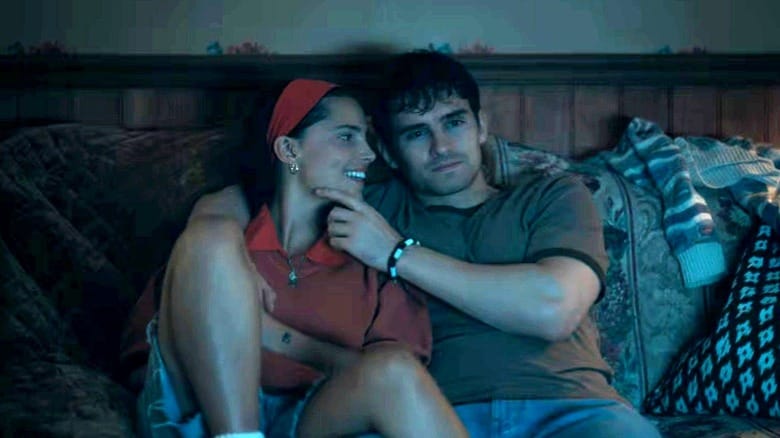
None of the above works if Johnston plays a creep, and he never does. The performance stays soft all the way down, through scenes where a lesser actor would start signaling villainy to protect himself from the audience’s judgment. Johnston refuses the signal. Bear cries real tears. His apologies sound like apologies. His guilt is genuine — and that’s the thing most takes on this character miss. The internet discourse wants Bear sorted into victim or monster, and the performance is built to make both filings impossible.
He feels terrible the way people doing something unforgivable often feel terrible: completely, sincerely, and without it changing a single decision. Johnston plays guilt as weather Bear experiences — it rains on him, he’s genuinely wet, and tomorrow he does the same thing. The film keeps asking, quietly, what that kind of guilt is worth. Anyone who has been on the receiving end of a tearful apology that preceded no change in behavior knows the answer, and knows it in their body before they could articulate it.
Taylor Clemons shoots him accordingly. The camera in Obsession sits at conversational distance, in ordinary rooms, in daylight that has no business being this menacing, and it grants Bear the same visual treatment as everyone else — eye level, ordinary light, the framing of a guy you know. There’s no low-angle menace, no shadow crawling up his face when he makes his worst choices. The cinematography commits to the same argument the script makes: this man would pass every test you could run on him from the outside. The horror has to be assembled by the viewer, from evidence, the way you’d assemble it about someone in your own life. Which is, I suspect, the point.
Bear’s Death: What It Settles
Bear dies at the end, by his own decision, and the wish breaks with him. I’ve covered the mechanics of those final minutes — including what Nikki’s own Willow likely did, which the film leaves open — in the Obsession ending explained piece, so here I’ll stay on what the death means for the character.
The tempting reading is redemption. The wish only breaks when one of them dies; he dies; she’s freed. I’ll admit I wanted that reading to hold. The film had spent ninety minutes making me half-understand him, and some part of me wanted the ending to pay that understanding back, to let the last act mean something clean. The film is smarter than my wanting. Bear understood the exit condition long before the end — the customer support call put it in plain language — and he declined it for as long as the arrangement was survivable for him. What finally moves him is the accumulated weight of what he caused landing all at once: Sarah, Ian, the letter he reads alone at sunrise. That’s collapse, arriving at the moment the damage becomes unlivable for Bear himself. The film lets you grieve him anyway, which is a more uncomfortable experience than judging him would have been.
And the released film sharpens this beyond what Barker originally wrote. In the script, Nikki followed Bear into death — a Romeo and Juliet close, the tragedy sealed in symmetry. Barker shot that version, then chose the one in theaters, where Nikki survives and retains every memory of her imprisonment. The choice denies Bear even the dark dignity of a shared ending. He exits; she inherits — the bodies, the questions, the years of memory she never consented to making. The truest consequence of a man like Bear in Obsession is what he leaves in the people who survive him, and the film’s last shot knows it.
Why Getting Bear Right Matters
Horror has spent decades on obsessive love, and most of it reaches for the wrong tools — the stalker in the shadows, the lunatic with the shrine, the monster whose obsession announces itself from the first frame. Those films are easy to watch because the threat is legible and the audience is never implicated. Nobody leaves Fatal Attraction wondering if they’re the problem. The controlling figures people actually encounter look like Bear: soft-spoken, wounded, generous on their own schedule, fluent in apology, convinced to their core that what they feel is love. The people who have lived inside a relationship like that — managed, monitored, slowly converted into a kept thing — almost never see it named accurately on screen. The screen keeps telling them their experience should have looked like a thriller. It looked like Bear making breakfast.
Barker built a portrait precise enough that recognition becomes the horror mechanism itself — for the people who lived it, and more uncomfortably, for the viewers who watch Bear’s reasoning unfold and find stretches of it familiar from the inside. A film that can do both at once is doing the genre’s most serious work, and the easy versions of Bear — pure victim of a cursed object, pure monster who deserved everything — both let the audience off a hook the film spent 109 minutes setting. That’s the conversation Bear in Obsession opens, and it’s one the genre has been avoiding for thirty years.
FAQ: Bear in Obsession (2026)
Is Bear the villain in Obsession (2026)?
Bear is the protagonist of Obsession (2026) and the source of its harm at the same time. He makes the wish that imprisons Nikki, then maintains it after learning she is conscious and suffering. The film treats him with sympathy and withholds absolution — his ordinariness is what makes him frightening.
Did Bear know the real Nikki was trapped?
Yes. The film confirms it twice. The real Nikki surfaces at night and begs Bear to end her suffering, and the One Wish Willow customer support call lets him hear her screaming. Bear continues the relationship with full knowledge of what it costs her.
What does Bear’s wish in Obsession actually say?
Bear wishes that Nikki would love him more than anyone in the world. The wording demands first place over every bond in her life, and the Willow executes it literally. The film’s horror flows from the sentence Bear himself composed, which is why the wish functions as a character confession.
Does Bear feel guilty in Obsession (2026)?
Yes, and the film treats his guilt as real. Michael Johnston plays Bear’s remorse as sincere — he cries, apologizes, and visibly suffers. The point is that his guilt never changes his behavior. Obsession argues that genuine remorse without changed action protects no one, which is central to Bear’s character.