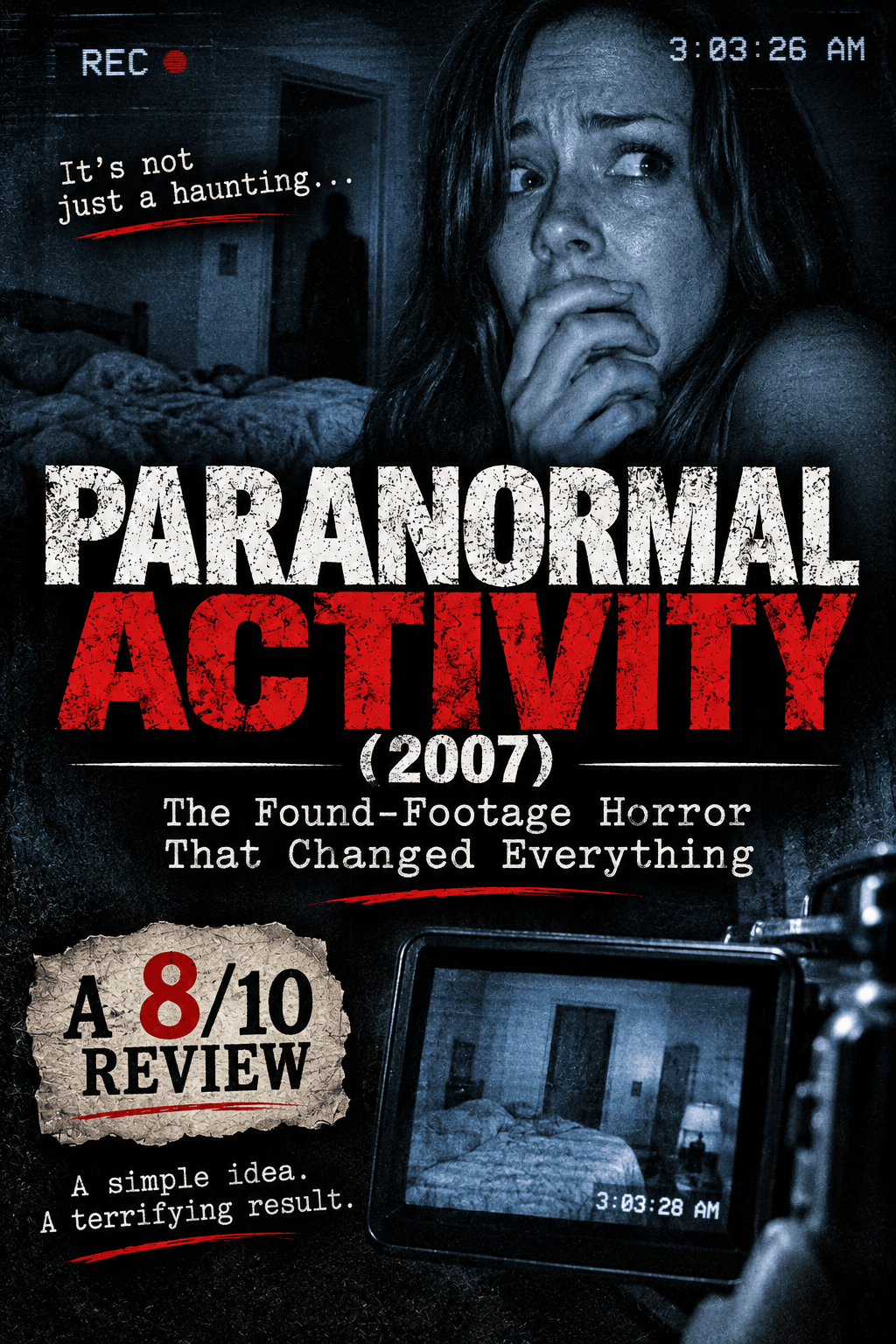
This Paranormal Activity 2007 review starts where the film itself starts: with Oren Peli, who wrote, shot, and edited the whole thing alone on a self-imposed seven-day schedule inside a rented house in Rancho Peñasquitos, San Diego. The result is a found-footage horror film about a haunting, and, more quietly, about a woman being disbelieved by the man filming her. Every frame of it exists because Micah Sloat decided it should.
He sets the camera on a tripod at the foot of the bed, angles it down the hallway, trails Katie toward the bathroom, carries it to the shed for the baby powder and the borrowed Ouija board. That belief — that he’s the one in control of what this camera catches — is the film’s real subject, and it’s the dynamic this film is actually documenting, long before anything starts banging on the walls at 3 a.m.
The Camera as the Real Haunting in Paranormal Activity 2007
Katie Featherston and Micah Sloat play versions of themselves, cast off a casting notice looking for unknown actors able to improvise. Peli’s method — no written dialogue, only outlines of situations, a technique since nicknamed retroscripting — produces a specific kind of realism a page of blocking never could. You can hear it in the small collisions: Katie correcting Micah’s math on what the camera cost, Micah needling her about a childhood “stalker” she clearly doesn’t want discussed on tape, the two of them negotiating, scene after scene, over where the camera goes and when it comes off.
Every one of those moments reads less like dialogue built for effect and more like an actual, unresolved disagreement — two people on the record, arguing about whether one of them gets to say no.
The psychic’s early questions force the film into something it rarely allows itself elsewhere: a plain account of who these two people are when the cameras aren’t catching anything supernatural. Katie is an English major a few credits from a teaching degree. Micah trades stocks for a living and works from home, which is part of why he’s always the one free to hold the camera. They’ve been together three years, a status they describe, half-joking, as being engaged to be engaged once she graduates.
That ordinary detail is what raises the stakes once things escalate: the audience already knows exactly how ordinary the life being wrecked was.
Featherston’s face does most of the film’s real work: small flinches, a pause before she answers, the exhaustion that creeps into her voice by the third sleepless night. Her fear is legible from the first night, when the two of them startle at a sound that turns out to be nothing worse than the icemaker, and she asks, almost as an aside, whether they really have to sleep with the camera running all night.
What comes through most clearly as the film goes on is exhaustion: the specific, accumulating tiredness of a person whose instincts keep being right and keep being overridden anyway. By the time she tells Micah to stop following her around the house with the camera, she sounds simply worn down — a person whose patience has run out, nothing more dramatic than that.
Sloat’s job is harder and less forgiving, because the film needs you to like Micah a little before it needs you to recognize what he’s doing. He’s charming in the early scenes in the exact register of someone who thinks charm is a renewable resource he can spend on other people’s boundaries.
Every one of Katie’s limits gets a workaround: she tells him no to the Ouija board, and he borrows one instead of buying it and calls that keeping his word; she tells him the camera in the bedroom scares her, and he treats the footage mainly as proof of his own competence. Sloat plays this without ever tipping into cartoon villainy, which is the performance’s real achievement — Micah believes, completely, that he is the one protecting Katie, and that belief is what makes him impossible to argue with.
Katie, Micah, and the Psychic Who Won’t Stay in the House
That belief is the film’s real subject. A psychic, credited as Dr. Fredrichs, shows up early in the story and tells them, matter-of-factly, that this falls outside his usual territory: ghosts are his specialty, and whatever’s loose in this house reads like something else entirely. He gives them the name of a demonologist instead, a colleague out of the country who won’t be back for days. By the time the psychic does come back, he can’t even stay in the house long enough to help — he admits his own presence is making things worse and leaves them to it.
Every institutional door the film opens closes again almost immediately, and what’s left standing in that vacuum is Micah’s conviction that he can solve this himself, on his own schedule, with his own camera, because it’s his house to solve it in. Katie keeps saying, in one form or another, that she knows her own fear better than he does. The film keeps proving her right and keeps costing her the argument anyway.
The film’s clearest illustration of that pattern arrives in two scenes that don’t involve the demon directly at all. Katie sleepwalks downstairs one night and sits motionless on the porch swing in the cold, and when Micah finds her and brings her back inside, she has no memory of leaving the bed. She asks him, flatly, what she looked like standing in the doorway; he describes it back to her, and she doesn’t recognize her own body in the description.
A few nights later, Micah climbs into the attic and comes down holding a photograph of a young Katie — one she says she hasn’t seen in fifteen years, lost in a house fire from her childhood, an object that should not exist, found in a space neither of them put it in. Both scenes do the same thing: they take something Katie should have exclusive authority over, her own sleeping body, her own childhood, and hand its explanation to the person standing over her with the camera.
Peli’s craft decisions all serve that claustrophobia without calling attention to themselves. The equipment itself was unglamorous by design — a consumer Sony HDR-FX1 camcorder, the kind a hobbyist could actually afford, mounted on a tripod and left running for hours at a stretch. There’s no score anywhere in the runtime — not one non-diegetic cue — so every sound the house makes has to carry its own dread without a cello telling the audience how to feel about it.
A footstep, a groan in the walls, the specific wrongness of a door swinging on a hinge nobody touched: all of it lands harder for arriving without a cue sheet. The nightly structure, time-lapsed footage snapping forward to real time the instant something moves, trains the audience to scan the corners of a static frame the way the characters themselves never quite learn to. It’s a primitive effect and an extremely cheap one, and it’s also the reason this film outperforms movies with a hundred times its budget. Dread, it turns out, scales with patience.
Context: A Decade-Old Trick Played Patiently
It’s worth sitting with how little this film actually needed to work. One location, two credited actors, a camera that cost less than a used car, and a script that was mostly a list of fights waiting to happen. Found footage had already proven, a decade earlier with The Blair Witch Project, that an audience will accept the premise of recovered tape as a substitute for craft they can’t see. What Paranormal Activity adds to that lineage is patience applied to a domestic set, with the horror built around two people’s incompatible accounts of the same house.
Oren Peli found the cheapest possible room to prove that dread through accumulation still worked.
Peli came to that room from a career in software — years as a programmer before he decided, in his late thirties, to try directing something cheap enough that failure wouldn’t cost him anything real. That background shows up most clearly in the film’s overall design: the haunting escalates on a schedule, one new variable added each night — a sound, then a photograph, then a door, then a shape. It reads like the pacing of someone used to thinking in increments, because that’s how the rest of his working life trained him to.
The film also spent roughly two years finding its audience before most people ever saw it. It played Screamfest in October 2007 to little notice, then Slamdance in January 2008, where Jason Blum first saw it and began the slow work of interesting a studio.
By the time Paramount ran its “Demand It” campaign in the fall of 2009 — letting audiences vote the film into their own local theaters, city by city, until the tally crossed a million requests on October 10 — the cut reaching those theaters had already been reworked more than once: Blum’s early re-edit, then the roughly $200,000 ending Paramount commissioned to replace the version test audiences had walked out of.
The film that eventually earned back more than ten thousand times its own shooting budget is, strictly speaking, several different productions stacked on top of one another, and almost nobody buying a ticket in October 2009 had any reason to know that.
The film’s afterlife says something its reputation sometimes undersells. DreamWorks executives initially wanted a bigger-budget remake, with this original shelved as a disc extra, until a test screening full of people walking out convinced Jason Blum and Peli that the walkouts were exactly the reaction they’d been hoping for. Steven Spielberg, according to a story reported by the Los Angeles Times and relayed since by multiple outlets without his own direct on-record confirmation, found his own copy of the disc behaving strangely enough that he had it hauled out of his house in a garbage bag.
Paramount’s “Demand It” strategy — a city-by-city ballot that let the film go wide only once a million people had asked for it — turned the whole release into a kind of referendum on whether dread this cheap deserved a real audience. It got one: upward of $190 million worldwide against a shoot that cost less than a modest wedding. Two decades later, the house hasn’t closed its doors for good — the next film in this franchise is set to return to it directly, with Peli himself producing alongside James Wan and Jason Blum.
Paranormal Activity 2007 Review: Final Verdict
Watching it now, at some distance from its reputation as the thing that terrified a generation of multiplexes, this Paranormal Activity 2007 review keeps circling back to one small moment, well past the attic photograph or the shape at the foot of the bed. It’s the smaller moment where Katie, mid-argument, tells Micah that the problem has never really been the house — it’s her, and wherever she goes, it goes. Micah treats that as a problem with a fix — something to solve, manage, and document — and he keeps filming anyway. That’s the real haunting this film documents.
It’s the reason the ending — whichever of the three endings Paramount and Peli eventually settled on — never quite feels like a twist. It feels like the thing the whole film was building toward from the moment he first picked up the camera over her objection and called it keeping her safe. I’d put this one at a 7.5 out of 10: a cheap, patient film that earns almost everything its reputation claims for it, by being honest about something uglier than a demon.
FAQ
Is Paranormal Activity 2007 based on a true story?
No. Oren Peli invented the haunting and the characters, though Katie Featherston and Micah Sloat play fictionalized versions of themselves, improvising dialogue from outlines rather than a written script, a technique called retroscripting.
Why does Paranormal Activity 2007 have three different endings?
The original ending, shown only once publicly, had police shoot Katie. Paramount commissioned two replacements: the theatrical ending, the only one with visual effects, and a home-release alternate where Katie kills Micah and takes her own life.
What’s the verdict in this Paranormal Activity 2007 review?
A 7.5 out of 10 — a cheap, patient found-footage film about exhaustion and control as much as about whatever is or isn’t haunting the house, and one that earns almost everything its reputation claims for it.