In Rio, the two men who stopped him on a dark street weren’t shouting. That’s the detail Ethan keeps coming back to when people ask why The Blair Witch Project still gets to him in a way almost nothing else in the genre does. He handed over what was in his pocket, they left, and the whole exchange lasted maybe ninety seconds of ordinary, unscored silence.
What stayed with him afterward was the sound of his own breathing, suddenly very loud, and a strange, clean clarity about which things in his life actually mattered — the men’s faces themselves barely registered next to that sound. Real fear, he’s since decided, is quiet and unhurried, usually gone before there’s time to brace for it.
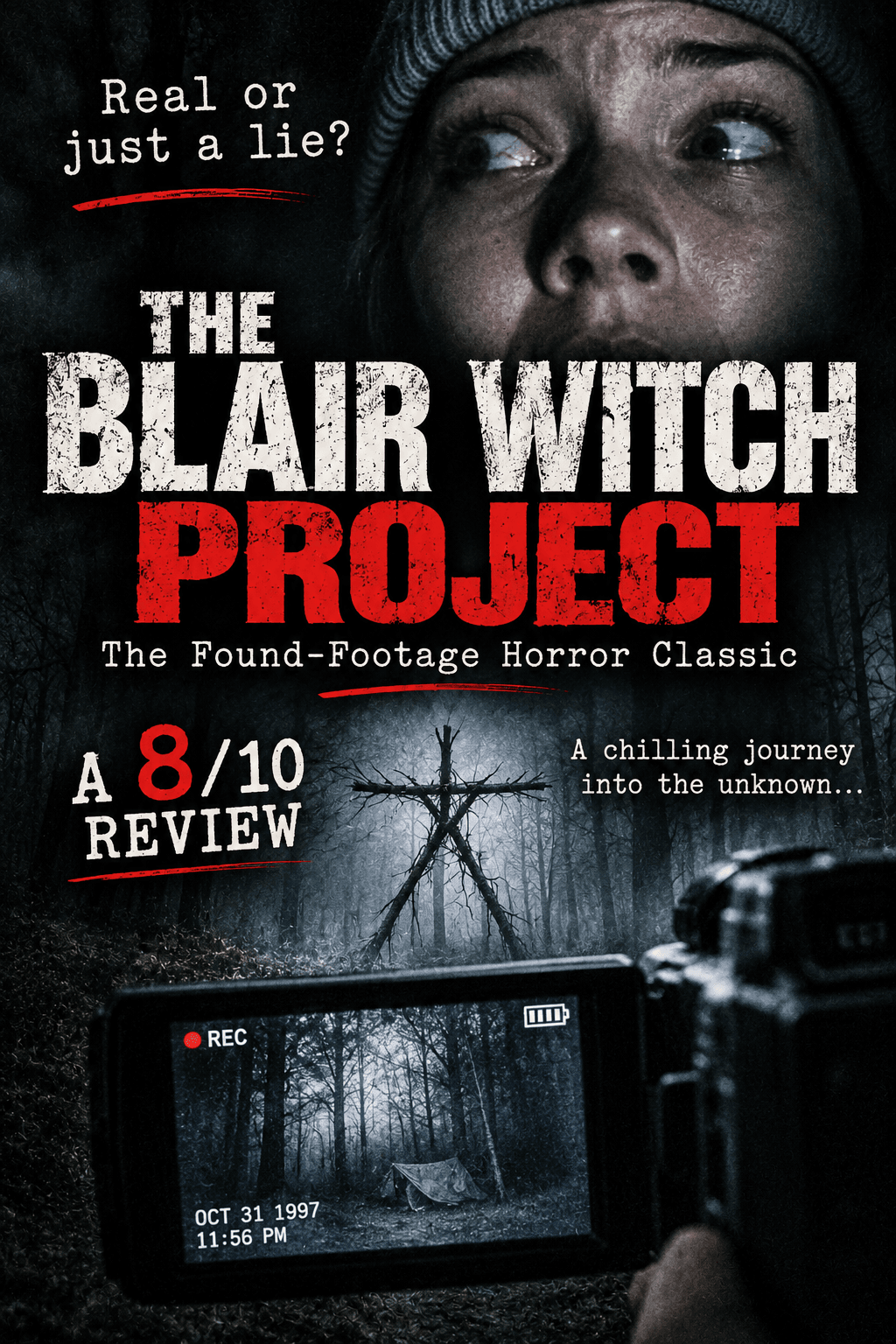
The direct answer, for anyone who just wants the verdict: this Blair Witch Project 1999 review lands at an 8 out of 10, because Daniel Myrick and Eduardo Sánchez’s found-footage debut still works as pure craft a quarter-century later, even once its marketing hoax and its three actors’ financial exploitation are weighed into the final score.
Myrick and Sánchez built an entire film out of the same observation Ethan took out of Rio, and it’s the reason The Blair Witch Project has outlived almost every film that tried to copy it. There is no score anywhere in the eighty-one minutes — no cue, sting, or orchestral stab ever arrives to tell the audience when to be afraid. The sound mix is stereo, not surround — a small, almost perverse technical choice that gives the film the thin, inconsistent audio amateur camcorder footage actually carries, the opposite of the lush, directional sound a horror movie usually wants.
What’s left is cracking branches, wind, and three people breathing too fast. It’s the most disciplined sound design decision in the found footage genre’s short history, and it works for exactly the reason Ethan’s ninety seconds in Rio worked on him: real dread arrives through proximity, the nearness of a shaking camera and a ragged, audible breath.
Myrick and Sánchez met as students at the University of Central Florida, where neither of them had much money, and the original pitch grew out of a documentary-about-a-documentary idea, closer in spirit to the 1970s pseudo-nonfiction they’d grown up scaring themselves with, shows like In Search Of… and schlock like The Legend of Boggy Creek. They’ve said that renting those tapes as adults, just to confirm the idea still worked, surprised them with how much it still did.
The specific, dated genre of cheap television convincing a kid that something out there might be real is the actual lineage this film comes from, closer to late-night cable than to Romero or any slasher franchise. What they built from it, on an eight-day shoot through Seneca Creek State Park in October 1997, inherited both halves of that genre: the low-fi plausibility and the willingness to lie about what the audience was watching.
The lie is the part that gets most of the attention, and it earns it. About six months before the film premiered at Sundance, a website went up presenting the backstory as a case file: three missing film students, fabricated police reports, grainy interview footage with actors playing the students’ families. IMDb’s own credits page carried no resolved status for any of the three, listed simply as missing for most of the film’s first year in circulation. The Sci-Fi Channel ran a mockumentary, Curse of the Blair Witch, that played the legend completely straight.
By the time the trailer leaked online in April 1999, people were already arguing in forum threads about whether any of it had actually happened, and traffic to the hoax site kept climbing with them, past 160 million visits by the month the film finally opened wide that August. None of this would be especially interesting as a marketing case study on its own; plenty of films have lied about their own premise.
What makes it different is that this particular lie was built entirely out of three real human beings’ actual names, and none of the three had any real say in how far it would go.
That’s the film’s real subject, as far as Ethan’s concerned, and it’s buried in plain sight, inside the footage itself. Watch what happens to Heather Donahue’s character across eighty-one minutes. She starts the film as the director, the one with the equipment list and the shooting schedule and the compulsive need to narrate her own competence into the camera, telling Mike on day one how pleased she is with her own choice of him for the crew, already performing authority for an audience that doesn’t exist yet.
By the third night, with the map gone and the piles of rocks multiplying outside the tent, that performance curdles into something closer to denial; she keeps the camera running specifically because, as Josh tells her, it’s all she has left. Donahue plays that slide without a single moment of actorly announcement, building the collapse out of an accumulation of smaller refusals to stop being the person in charge, until the refusal itself becomes the character’s entire emotional content.
By the final night, alone with the camera, she delivers an apology that names Mike’s mother, Josh’s mother, her own mother, one at a time, and then collapses the whole structure of the film’s first act into a single sentence: it was her project, she insisted, everything had to be her way.
It’s a genuinely great piece of acting, unbroken and almost unwatchable in its specificity, and the Golden Raspberry voters gave her their Worst Actress award for it anyway, the same year an online critics’ society nominated her for Best Actress for the identical performance — two juries looking at the same eighty-one minutes and arriving at opposite verdicts about who deserved the blame for feeling fooled.
Michael C. Williams gets less credit, possibly because his performance is quieter and less quotable, but watch what he does with Mike’s anger once the map disappears. Williams plays controlled irritation for most of the film — the guy rolling his eyes at Heather’s documentary instincts, annoyed but still cooperative — right up until the admission that he kicked the map into the creek because, in his own words at the time, it wasn’t helping them anymore.
The accusation that follows, that Heather and Josh have both wrecked things for the group, reads as a man realizing, in real time, that his own small act of self-sabotage has removed the one tool that might have gotten them out, with no way left to take it back. Williams carries that particular flavor of guilt curdling into blame through the rest of the film, and it pays off in the climax, when he’s the one who walks toward Josh’s voice in the basement against Heather’s direct pleading not to.
The same compulsion that made him kick the map in the first place, the conviction that doing something, anything, beats doing nothing, is the last decision either character gets to make on camera.
None of that performance existed on a page before the cameras rolled. Myrick and Sánchez worked from a thirty-five-page outline, closer to a logistics document than a conventional shooting script, and gave the three actors nothing beyond written instructions left in film canisters at GPS waypoints, composed by directors shadowing them from a distance who, by their own account, didn’t fully grasp the rules they were breaking, since nobody had broken them in quite this configuration before.
They moved the actors through the woods at night, cut their food, and let producer Gregg Hale’s old military-logistics instincts decide how disoriented three unprepared twenty-somethings should actually get. Cinematographer Neal Fredericks shot it on a CP-16 for the black-and-white film reels and handed the actors a Hi8 camcorder for the color video, chasing, in his own words, a look that was “as natural and as real as possible,” which meant teaching three non-cinematographers to operate cameras competently enough that the imperfections left in the final cut would still read as authentic.
Myrick and Sánchez edited the roughly twenty hours of resulting footage down to eighty-one minutes themselves, over more than eight months, on a nonlinear system nobody remembers fondly. Every element of the craft here works to erase its own fingerprints, a harder trick than it looks, and the film has spent twenty-five years being credited for that trick while the three people who made it convincing got credited for almost nothing at all.
Here’s where Ethan’s Cold Fury stops being a mood and starts being an argument. The contract the three actors signed, through the production company Haxan Films, promised them one percent of profits if the film crossed a million dollars in gross, a number that, at the time, must have sounded like a joke nobody needed to read the fine print on. Williams has said as much: who seriously plans for a sixty-thousand-dollar film to clear that bar.
It cleared it by roughly two hundred and fifty times, somewhere north of two hundred and forty-eight million dollars worldwide, and the three people whose faces, names, and terrified improvisation generated that number received, by their own later account, almost nothing proportional to it: a performance bump in the low five figures that summer, little else, and a contractual requirement to disappear from public view so the missing-persons illusion could keep working, unable to take other acting jobs or even discuss what they were or weren’t being paid.
They absorbed, in full, the consequences of a hoax that the studio had designed and that the studio alone profited from executing. Donahue has described the backlash that followed as never really letting up, strangers in real life demanding real refunds from her personally, as if she, and not the studio, had committed the fraud she’d simply acted in. She eventually changed her legal name.
Williams and his family were, as of the film’s own anniversary press cycle, living in a one-bedroom apartment after a flood took their house, a fact he has discussed publicly with the specific, exhausted bitterness of someone who has had two and a half decades to think about it, saying plainly that large corporations don’t care what happens to young artists in the process.
They sued Artisan Entertainment around 2000, ahead of the sequel nobody asked them about, and settled for three hundred thousand dollars each, a figure that looks a lot more like severance than justice once it sits next to two hundred and forty-eight million.
What makes this worth dwelling on, in a review that’s ostensibly about whether a twenty-five-year-old horror movie still works, is that the fictional betrayal inside the film and the real one that happened to the people making it are built from the identical mechanism. Heather loses control of her own narrative to something larger and unseen in the woods, and the film’s whole tragedy is that none of her insistence, her maps, her compasses, her documentary instincts, can get that control back.
Off camera, in the real world, that’s exactly what happened to Donahue, Williams, and Leonard, except the thing that took their names, their likenesses, and the bulk of what their work generated wasn’t a witch. It had a legal department.
The film dresses up a genuinely old and genuinely real fear — three young people, lost, slowly discovering that the people who were supposed to be looking out for them either can’t or won’t — and it does this so well that almost nobody noticed, for a quarter of a century, that the exact same story was happening to the actors playing them, just slower, and without a camera running.
The Blair Witch Project still works as a horror film because it figured out, before almost anyone else in American cinema, that silence is scarier than a score and that a camera held by someone genuinely frightened records something a stunt crew can’t fake. It still works as a piece of cultural history because the hoax it ran was good enough to fool a pre-broadband internet into treating a fictional disappearance as evidence. It should also work, going forward, as a cautionary tax record for anyone who still thinks exposure is a form of payment.
Ethan left Rio with his wallet lighter and nothing else taken from him. The three people who made this film left the woods with a great deal more taken, and spent the next twenty-five years trying to get even a fraction of it back on the record.
The Blair Witch Project 1999 Review: Final Verdict
This Blair Witch Project 1999 review wouldn’t be complete without saying plainly that the film isn’t the only found footage hoax that cost its real participants more than it ever paid them. Cannibal Holocaust’s own 1980 true story carries a far darker version of the same math, with real animal deaths standing in for a marketing lie. The Blair Witch Project’s version is bloodless by comparison, but the shape of the exploitation is the same: a studio profits from a hoax built out of real people’s names, and the people get a performance bump while the studio keeps the rest.
Ethan’s Score: 8 / 10
Frequently Asked Questions
What does this Blair Witch Project 1999 review conclude about whether the film is worth watching?
This Blair Witch Project 1999 review lands at 8 out of 10. The no-score sound design and the unscripted performances from Heather Donahue, Michael C. Williams, and Joshua Leonard still generate real dread twenty-five years later, even once the viral marketing hoax and the actors’ own financial exploitation are weighed into the final verdict.
Were Heather Donahue, Michael C. Williams, and Joshua Leonard really paid almost nothing for the film’s success?
Close to it. Their contract promised one percent of profits above a one-million-dollar gross; the film cleared that bar roughly two hundred and fifty times over, yet the three actors received only a small performance bump that summer, were barred from other acting work, and later settled a lawsuit against Artisan Entertainment for three hundred thousand dollars each.