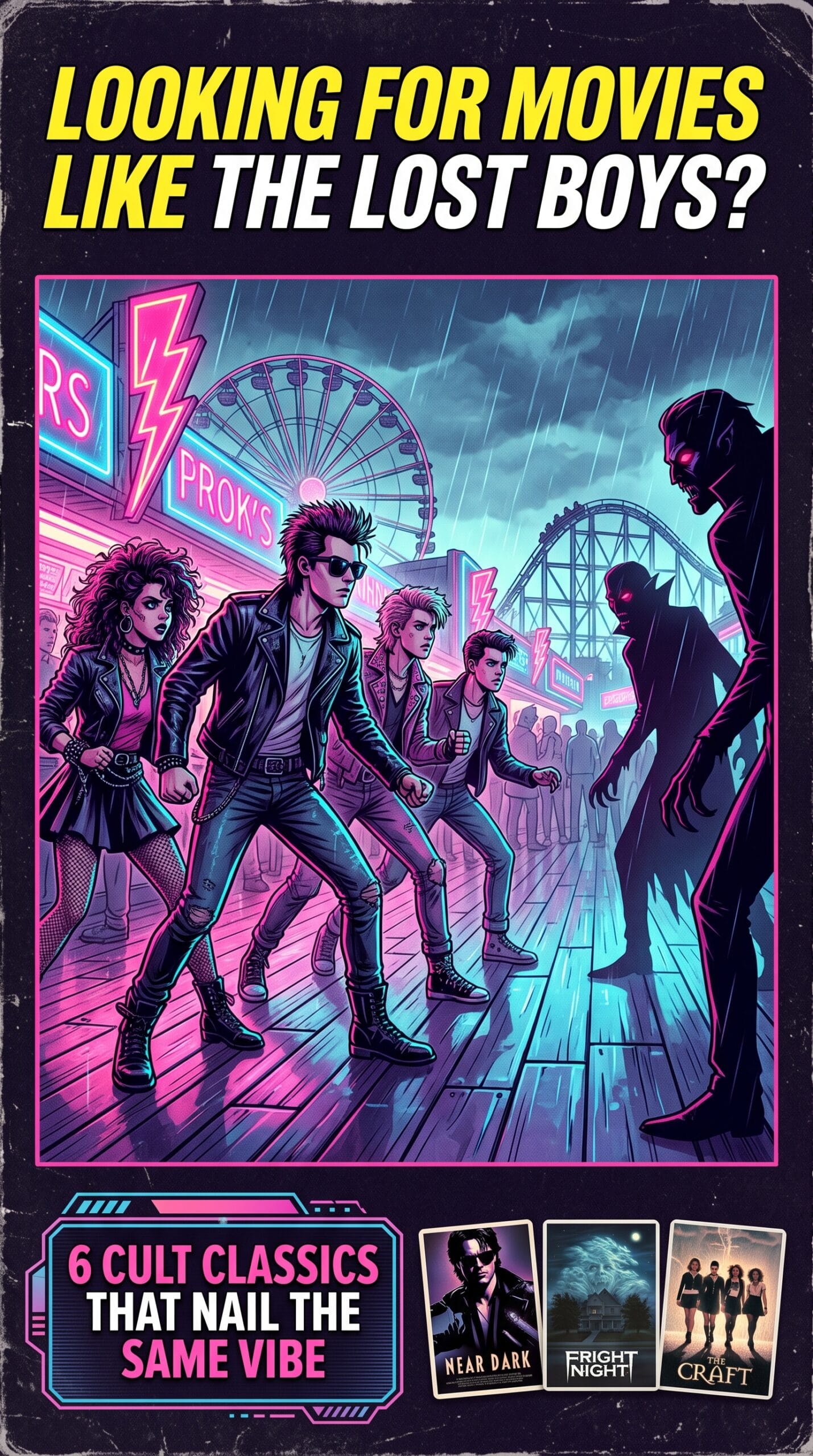
The closest films to The Lost Boys (1987) — the ones that share its real subject, not just its decade or its fangs — are Near Dark (1987), Fright Night (1985), The Monster Squad (1987), What We Do in the Shadows (2014), Buffy the Vampire Slayer (1992), and The Craft (1996). People who search for movies like The Lost Boys are rarely asking for more vampires. They already know where to find those.What they’re actually asking for is harder to name, so they reach for the film that named it best: a story about a kid whose family has already come apart, who gets offered a second one on a motorcycle at the edge of a boardwalk, and who has to decide, fast, which broken thing he’s willing to belong to. The vampirism is the delivery system. The ache underneath it is the thing people actually remember.That ache shows up, in different costumes, across a small cluster of films that either surround The Lost Boys in time or answer it directly in structure. Some of them are vampire movies. One isn’t a vampire movie at all. The thing that actually connects them is the proposition Michael Emerson gets offered at Santa Carla’s boardwalk: leave the family that failed you, join the family that wants you, and find out what that actually costs before the first sunrise makes it permanent.None of the six films below set out to remake
The Lost Boys, and most of them didn’t have the chance to try — two were already finished by the time Schumacher’s film opened (both get their own entries in
our survey of the best vampire movies, grouped alongside it as the genre’s own 1980s split), one opened two weeks after it and got flattened by the comparison, and the rest arrived years or decades later, working from a version of the genre The Lost Boys had already rewired.What they share is the shape of the bargain underneath the tone, regardless of whether the tone is dread or comedy or camp: somebody young, somebody isolated, gets handed belonging by people who are dangerous, or ridiculous, or both, and has to work out — usually alone, usually too late to undo the first mistake — what that belonging is actually going to cost them.
Near Dark (1987): The Same Year, A Colder Answer
Near Dark opened in American theaters on October 2, 1987, roughly two months after The Lost Boys, and it tells almost the same story with the temperature turned all the way down. Caleb, a young Oklahoma man played by Adrian Pasdar, gets bitten by a drifter named Mae and pulled into a nomadic vampire family led by Jesse Hooker.The gang — Jesse, the volatile Severen, the predatory Diamondback, a child vampire named Homer wearing an adult’s hunger in a kid’s body — functions exactly the way David’s gang functions in Santa Carla: as a substitute household, complete with its own hierarchy, its own rules about loyalty, and its own quiet cruelty toward anyone who hesitates.Where The Lost Boys stages this as seduction — leather jackets, a boardwalk, a soundtrack built to make you want in — Near Dark stages it as attrition. Kathryn Bigelow, directing her solo debut, shoots the vampire family as a traveling wound, working empty highways and cheap motel rooms, the outer edges of the country where a family like this could actually hide. Caleb doesn’t get to enjoy his new family before the cost becomes visible. He’s made to kill almost immediately, and the film spends its runtime watching him try and fail to become the thing that would let him stay.Critics eventually caught up to what Bigelow built. The film holds an 81% approval rating on Rotten Tomatoes, with the site’s consensus calling it “at once a creepy vampire film, a thrilling western, and a poignant family tale” — three genres stitched together so cleanly that none of them feel like the costume the other two are wearing underneath. That’s the film’s real achievement: it takes the exact bargain The Lost Boys offers and refuses every comfort that makes the bargain look appealing on screen, stripping out the boardwalk, the soundtrack cue, every signal telling you it’s safe to want this.What’s left is just Caleb, further from home with every passing motel, discovering that a family built on hunger doesn’t get gentler once you’ve joined it.The real story here, though, is what happened after release. Near Dark made $3.4 million domestically against a $5 million budget, a serious underperformance, and Bigelow attributed a real part of that failure directly to The Lost Boys, which had opened two months earlier with what she called “a tremendous amount of muscle” behind it, compared to her own film’s “little… whisper.” Two vampire movies, same year, same basic premise, and the one with the studio push and the mall-ready soundtrack ate the other one’s box office alive. That’s not a footnote.It’s the same theme the films themselves are both telling — belonging goes to whoever makes the better offer — playing out one more time, off screen, between the studios that made them.
Fright Night (1985): The Film That Got There First
Fright Night beat The Lost Boys to theaters by two years, opening August 2, 1985, and it’s worth watching precisely because it proves the teen-vampire formula didn’t start on a boardwalk. Tom Holland’s directorial debut gives you Charley Brewster, a suburban teenager who becomes convinced his new next-door neighbor Jerry Dandrige is a vampire, and nobody believes him — not his mother, not his girlfriend, not the police.His only ally ends up being Peter Vincent, a washed-up horror-movie TV host played by Roddy McDowall, who has spent his whole career pretending to fight monsters on a soundstage and now has to do it for real.There’s a second, smaller relationship worth watching underneath the main one: Charley’s best friend Edward “Evil Ed” Thompson, played by Stephen Geoffreys, is the film’s most tragic figure precisely because he’s the one who wants what David’s gang is selling before David’s gang exists to sell it. Ed wants to be let in, not to stop Jerry — he’s already an outsider at school, already mocked, already primed to find a vampire’s contempt for ordinary people more appealing than ordinary people’s contempt for him. He gets what he asks for, and the film doesn’t pretend it’s a victory.The family wound at the center of The Lost Boys isn’t really here. Charley has a mother, present if distracted; he isn’t being offered a replacement household so much as a replacement version of adulthood, embodied by Peter Vincent’s arc from washed-up performer back into someone whose skills actually matter.What Fright Night does share with The Lost Boys, and does first, is the idea that a vampire could move into ordinary American suburbia and be genuinely, dangerously charming about it — Chris Sarandon’s Jerry Dandrige is polite, funny, and reasonable right up until he isn’t, the same trick David plays on Michael two years later with better cheekbones and a worse motorcycle.Fright Night made $24.9 million domestically against a budget between $7 and $9.25 million, the best-performing horror film of that summer, and critics received it warmly — an 83% score on Rotten Tomatoes, Roger Ebert giving it three stars and noting it “has a lot of fun being undistinguished.” That box-office success is part of why the genre had somewhere to go by 1987. The suburban-neighbor-vampire had already worked once.The Lost Boys took the same basic promise and moved it to a beach town full of teenagers with nowhere else to be, which turned out to be an even better idea.
The Monster Squad (1987): Two Weeks Later, a Different Kind of Family
$3.8 million domestically against a $14 million budget, pulled from theaters almost immediately — that’s what happened to The Monster Squad when it opened August 14, 1987, exactly two weeks after The Lost Boys, in part because the R-rated Lost Boys had already claimed the older teenage audience the PG-13 Monster Squad needed.Fred Dekker’s film, co-written with Shane Black, follows a club of monster-obsessed pre-teens — Sean, Patrick, the overweight and unfailingly brave Horace, the tough older kid Rudy, Sean’s younger sister Phoebe — who have to stop Dracula and a full roster of Universal’s classic monsters from ending the world with an ancient amulet.It’s a different register almost entirely — broader, sillier, built for an audience several years younger than the one buying tickets to watch Kiefer Sutherland dangle a teenager off a train trestle. But the structural DNA is the same one running through every film in this cluster: a group of kids who don’t quite belong anywhere else find each other, and the thing they find together — a shared secret, a shared threat, a shared willingness to be believed by nobody but each other — becomes more binding than the families most of them go home to at night.Phoebe’s quiet friendship with Frankenstein’s monster, the film’s most sincere relationship, runs on the exact same wire as Star and Laddie’s need for someone, anyone, to actually see them as more than convenient.What The Monster Squad understands that The Lost Boys mostly leaves alone is comedy without menace — nobody in this club is being groomed into anything. That’s precisely why it’s worth watching next to it. Put the two films side by side and you can see the same premise split down the middle: one version where the found family is dangerous because it wants something from you, and one version where it’s safe because all it wants is you.Contemporary critics were unconvinced — a 53% Rotten Tomatoes score, a 61/100 from Metacritic — but the reassessment has been kind, retrospective writers pointing to its “scrappy, ramshackle charm” as the thing that actually earned it a cult following decades later, long after “Wolfman’s got nards” outlived the box office receipts entirely, a catchphrase durable enough that a documentary about the film’s cult afterlife reportedly borrowed it for a title. That afterlife pattern should sound familiar.It’s the same one The Lost Boys itself had — a film critics dismissed at release (Ebert gave it two and a half stars, calling it “a triumph of style over substance”; Variety was harsher still) before it settled into the thing an entire generation quotes from memory. Being the smaller film in a crowded summer, or the film critics didn’t take seriously, can cost you the argument for years, sometimes decades — but rarely for good.
What We Do in the Shadows (2014): When the Vampire Family Becomes a Sitcom
Jemaine Clement and Taika Waititi’s mockumentary follows four vampire flatmates — Viago, Vladislav, Deacon, and the newly undead Nick — sharing a flat in Wellington, New Zealand, and the joke that carries the entire film is one The Lost Boys never quite tells on itself: what does the vampire gang look like on a Tuesday, when nobody’s feeding and nothing’s dying? The answer, it turns out, is roommates arguing about whose turn it is to do the dishes, whose coffin is whose, and whether the new guy is embarrassing the household in front of company.David’s crew never has to face this. Their whole appeal depends on staying in the boardwalk-and-cave version of themselves, glamorous right up until the moment they aren’t. What We Do in the Shadows takes the same premise — a vampire “family” bound by shared secrecy and shared hunger, a household without a single blood relative in it — and asks the question The Lost Boys is too cool to ask: what happens to a found family once the found part has worn off and it’s just a family, with all the small grievances and petty hierarchies that word implies.Vladislav still resents losing a centuries-old rivalry. Viago still can’t get over a lost love from 1912. Deacon still refuses to do his share of the chores. It’s the same household David runs, minus the mythology, stripped down to the part where living with anyone, dead or otherwise, eventually just means living with them.The film earned a 96% critical score on Rotten Tomatoes, with reviewers calling it “smarter, fresher, and funnier than a modern vampire movie has any right to be.” What makes it worth sitting next to The Lost Boys is the honesty underneath the comedy. Every vampire-gang-as-family story since 1987 has had to reckon, one way or another, with the fact that families — the blood kind, the bitten kind, the flatmate kind — are exhausting to actually live inside. This is the one that admitted it out loud.
Buffy the Vampire Slayer (1992): The Mirror Image
Fran Rubel Kuzui’s film, written by Joss Whedon, flips the entire premise of The Lost Boys and doesn’t bother hiding it. Kristy Swanson’s Buffy Summers is a California Valley Girl cheerleader who discovers she’s the Slayer, trained by her Watcher Merrick to hunt the vampire Lothos and his minion Amilyn.Where Michael gets pulled toward the gang, seduced by exactly the kind of cool, dangerous belonging David is offering, Buffy gets pulled away from an equally seductive version of normal teenage life and toward the responsibility of fighting the thing Michael almost joined — the same sun-bleached California setting and the same teenage stakes, run through a completely inverted protagonist.The film itself did modestly at the box office — $16.6 million against a $7 million budget — and reviewers were unkind at the time, Rotten Tomatoes settling at 36% with a “B+” CinemaScore from actual audiences telling a different story. But Whedon’s fingerprints on this material didn’t end with the 1992 film.When he built out the mythology for the television series years later, he has said the vampire character Spike — not a figure from this movie, a creation of the show — was designed as “a little Billy Idol, a little Kiefer Sutherland in The Lost Boys, and every guy in a black coat.” That’s a direct, on-the-record admission that the aesthetic David pioneered — dangerous, stylish, impossible not to want to follow — became a template Whedon kept returning to, first in this film’s genre bones and later, explicitly, in the character he built to embody it.Put next to The Lost Boys, Buffy the Vampire Slayer plays like an answer as much as a companion piece. Every choice Michael makes toward the gang, this film has its heroine make in reverse. Watching them together is watching the same California adolescence get resolved two entirely different ways.
The Craft (1996): A Different Kind of Coven
Nothing in The Craft has fangs, and it belongs on this list anyway. Andrew Fleming’s film follows Sarah Bailey, a transfer student with latent powers, who’s welcomed into a coven of three outcast girls at a Los Angeles Catholic high school — Nancy, sharp and furious and poor; Bonnie, carrying real physical scars; Rochelle, facing racial harassment she has no other way to answer. Sarah completes their circle, and for a while, the four of them get exactly what David’s gang promises Michael: power, belonging, and a version of themselves nobody at school gets to laugh at anymore.It curdles the same way. Nancy, given real power for the first time in her life, doesn’t know how to want anything smaller than everything, and the film spends its second half watching the found family that saved these girls from isolation become the thing that isolates Sarah instead — she’s the one who ends up having to walk away from the circle and bind the friend who won’t stop taking.That’s the exact machinery running under Michael’s story, just relocated from a boardwalk to a coven: belonging that’s offered freely at first always turns out to have a bill attached, and somebody in the group is always the one who finds out first how high that bill actually runs.The Craft made $55.6 million worldwide against a $15 million budget, a genuine commercial success despite reviews that split almost exactly down the middle — critics complaining its “campy magic often overrides the feminist message” while conceding its cast and premise “still cast a sporadic spell.” It’s outlasted that mixed reception the same way The Lost Boys did, because both films told the truth about what it actually feels like to be handed a family you didn’t grow up with, and to realize too late that you’ll have to decide, alone, what you’re willing to give back for it.
The One That Doesn’t Quite Belong: Vamp (1986)
It’s worth naming the film that almost made this list and didn’t earn a full section: Vamp, released a year before The Lost Boys on July 18, 1986, following a trio of fraternity pledges who go looking for a stripper to hire for their initiation and stumble into a club run by a centuries-old vampire named Katrina, played by Grace Jones. It made $4.9 million domestically against a $3.3 million budget — a small, forgettable hit that never had the cultural weight to argue with anything.It has the same nightclub-as-hunting-ground energy as Santa Carla’s boardwalk, the same sense of a subculture hiding in plain sight in a city nobody’s watching closely enough. What it doesn’t have is the family wound. Nobody in Vamp is looking for somewhere to belong — they’re looking for a way out of a bad night, and the vampire at the center of it is scenery more than she’s a temptation.It’s a reminder that not every vampire film from this stretch of the decade is actually doing what The Lost Boys is doing, even when the marquee and the fog machines look almost identical.
Why “Movies Like The Lost Boys” Keeps Getting Searched
None of these six films are trying to be The Lost Boys. Near Dark actively resents it. Fright Night came first. The Monster Squad got run over by it in theaters two weeks after opening. What We Do in the Shadows spent thirty years waiting to make fun of it with real affection. Buffy the Vampire Slayer argued with it. The Craft never mentioned it once and didn’t need to.What ties them together is a question none of them, including The Lost Boys, ever answers comfortably: once somebody offers you a family, on a motorcycle or in a coven or on a Wellington sofa, how do you find out what it actually costs before you’ve already said yes. Every film on this list stages that same gamble in a different key — dangerous, silly, exhausting, seductive, corrosive — and every one of them lands on roughly the same unglamorous truth.The families we choose ask more of us than the ones we’re born into, precisely because we chose them, and there’s no refunding a choice like that once the sun comes up on it.That’s the real reason “movies like The Lost Boys” keeps getting searched, year after year, decades after Santa Carla stopped being anyone’s idea of the future. It was never really about vampires. It was about watching someone else stand at that boardwalk railing, weighing an offer that sounds like freedom and smells like a trap, and recognizing exactly how long it takes to figure out which one it actually is.
Frequently Asked Questions
What are the best movies like The Lost Boys (1987)?
The closest matches are Near Dark (1987) and Fright Night (1985) for tone and vampire mythology, The Monster Squad (1987) for its found-family kid gang, What We Do in the Shadows (2014) for a comedic take on the same vampire-household premise, and Buffy the Vampire Slayer (1992) for a direct, gender-inverted answer to David’s whole seduction routine.
Do any of these movies actually reference The Lost Boys directly?
Yes. Joss Whedon has said the Buffy the Vampire Slayer TV series’ vampire Spike was designed as “a little Billy Idol, a little Kiefer Sutherland in The Lost Boys, and every guy in a black coat” — a direct, on-the-record admission that David’s aesthetic shaped a character Whedon built more than a decade after his own 1992 film.